Cross Pass (Georgian Military Highway)
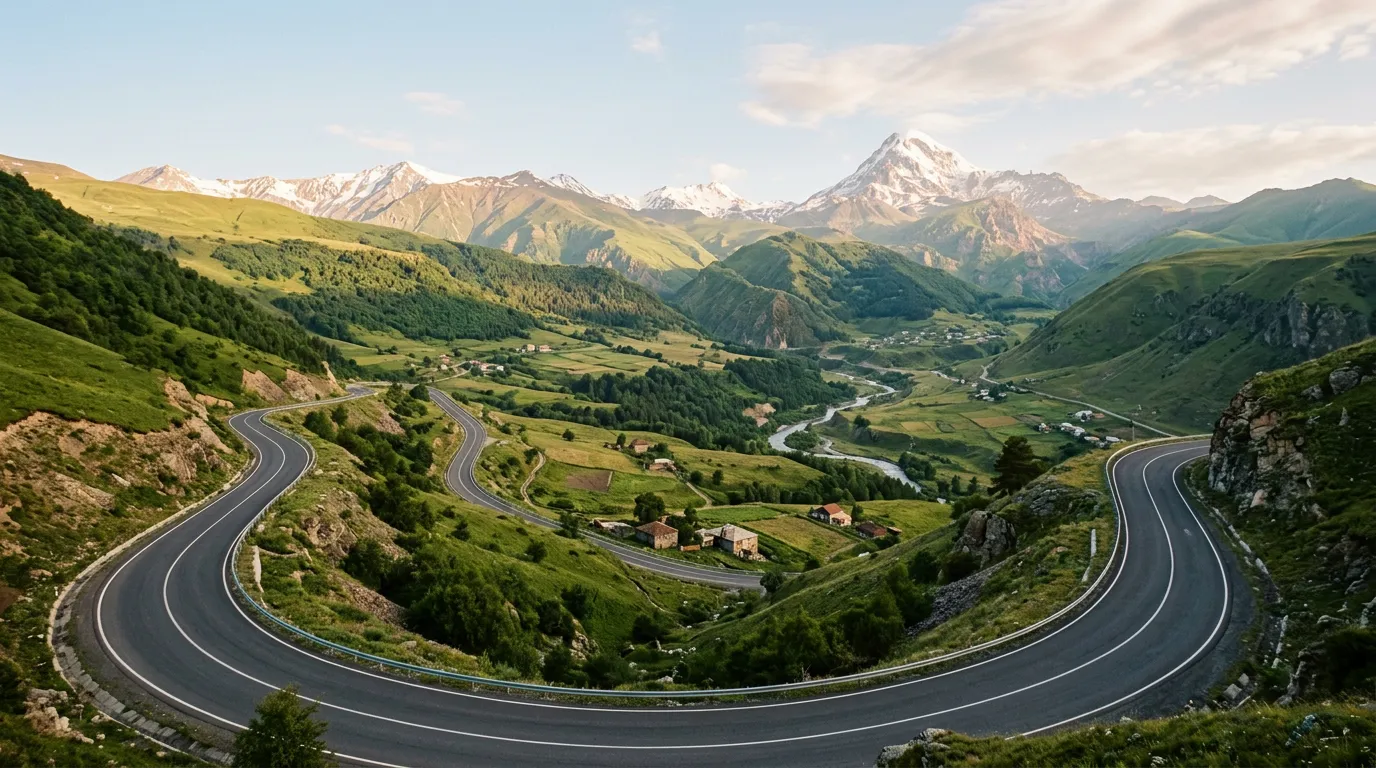
If you are going to drive one mountain road in Georgia, this is the one. The Georgian Military Highway runs 212 kilometers from Tbilisi to the Russian border, but the section that matters – the 40-kilometer climb from the Aragvi Valley over the Cross Pass at 2,379 meters and down into the shadow of Mount Kazbek – is one of the great mountain drives in the world. It has been exactly that for over two thousand years. The route was a trade path before the Romans, a military corridor for the Russian Empire, a supply line for the Soviet Union, and today it is a paved, potholed, occasionally terrifying introduction to what the Caucasus does to a road.
We have driven this highway six times at last count, in different seasons, different cars, and different states of road repair. It is never the same drive twice. The potholes migrate, the tunnel lighting works or does not, the weather at the summit has its own agenda, and the truck traffic ranges from manageable to absurd. But the bones of the road – the valley approach, the medieval fortress, the climb through alpine meadows to the cross at the summit, and the descent with Kazbek’s 5,047-meter glaciated peak filling the windshield – those never disappoint.
Why drive Cross Pass
Three reasons, in order of importance.
First, Mount Kazbek. The northern descent from Cross Pass delivers you into the Truso and Dariali gorges with a head-on view of one of the highest peaks in the Caucasus. The mountain appears suddenly as you round a curve, enormous and glacier-covered, and it dominates the landscape for the entire descent to the town of Stepantsminda (still called Kazbegi by everyone). We have seen the Alps, the Dolomites, the Norwegian mountains. Few approaches to a peak match this one for sheer drama.
Second, the historical weight. Every conqueror, trader, and traveler who crossed the Caucasus between Europe and Asia used this route. Alexander the Great may have. The Persian, Mongol, and Ottoman empires certainly did. Pushkin wrote about it. Lermontov painted it. Tolstoy rode through on horseback. When you drive this road, you are following a path carved by twenty centuries of human ambition and geography’s indifference to it.
Third, it is accessible. Unlike the Tusheti Road, which requires a proper 4x4 and a willingness to accept personal risk, Cross Pass is a paved highway suitable for any car with functioning brakes. The difficulty is real – the gradient sustains 8-10% for long stretches, the switchbacks demand attention, and the tunnel near the summit is an experience in itself – but this is a drive that a competent driver in a rental sedan can complete comfortably. It is the gateway drug to Caucasus mountain driving.
Which direction to drive
South to north – Tbilisi to Kazbegi. Without hesitation.
The southern approach builds gradually. You leave Tbilisi through suburban sprawl, pick up the highway along the Aragvi River, and the mountains close in slowly. Each element arrives in sequence: the riverside valley, then Ananuri Fortress perched above the Zhinvali Reservoir, then the climb through Gudauri’s ski resort, then the tunnel, then the cross at the summit, then the revelation of Kazbek. It is paced like a well-structured film.
Driving north to south gives you Kazbek first, which is like opening a novel by reading the last chapter. Everything after the initial view feels like diminishing returns. The southern valley is beautiful, but it cannot compete with the mountain you are driving away from.
If you are doing a round trip from Tbilisi (the most common itinerary), drive north in the morning, spend the day in Stepantsminda, and return south in the evening. The afternoon light on the southern descent is excellent.
Kilometer by kilometer
Km 0-15: Tbilisi to Mtskheta
The highway begins at the northern edge of Tbilisi and follows the Mtkvari River to Mtskheta, the ancient capital of Georgia and a UNESCO World Heritage site. At the confluence of the Mtkvari and Aragvi rivers, the Jvari Monastery sits on a hilltop overlooking both valleys. A short detour up the access road to Jvari is mandatory – the view of Mtskheta and the river junction from the monastery terrace is one of the most photographed scenes in Georgia.
The road in this section is a proper highway: dual carriageway, good asphalt, moderate traffic. Nothing here suggests the mountain road ahead.
Km 15-45: Aragvi Valley
North of Mtskheta, the highway follows the Aragvi River upstream through a narrowing valley. The road is two lanes, paved, with occasional potholes that require attention. Traffic is a mix of local cars, tourist minibuses, and cargo trucks heading for the Russian border. The scenery is pleasant valley landscape – forested hills, river bends, roadside fruit sellers in season.
At km 40, the Ananuri Fortress appears above the Zhinvali Reservoir. The fortress is worth a stop: 13th-century defensive towers, two churches with carved facades, and a view across the reservoir that establishes the scale of what is ahead. The water is a startling emerald color that photographs well.
Km 45-75: The climb through Gudauri
The road begins climbing in earnest after the reservoir. The gradient increases to a sustained 6-8%, the valley falls away below, and the landscape shifts from forested hills to alpine grassland. The Gudauri ski resort sits at roughly 2,200 meters – a collection of hotels and lift stations that serves as a reference point for the altitude gain.
Switchbacks begin at Gudauri, though they are wide and well-engineered compared to what other countries consider acceptable. The asphalt quality varies – repaired sections alternate with stretches that have not been resurfaced since the Soviet era. The guardrails are present but do not inspire total confidence. The views, however, are now enormous: the valley you climbed from is visible far below, and the greater Caucasus ridge is beginning to reveal itself to the north.
Km 75-85: The tunnel and the Cross
Near the summit, the road enters the Jvari Tunnel – approximately 700 meters long, poorly lit, occasionally occupied by vehicles moving in both directions despite the theoretical one-way traffic system. Drive slowly, use your headlights, and be prepared for oncoming traffic. The tunnel is functional rather than comfortable.
Emerging from the tunnel, you reach the Cross Pass summit at 2,379 meters. A large cross monument marks the high point, and a parking area allows you to stop and absorb the panorama. In clear weather, the view extends across the Greater Caucasus range in both directions. In fog – which is common – you see approximately thirty meters and must trust that the road continues.
Km 85-110: The descent to Kazbegi
The northern descent is the climax. The road drops from the summit through a series of switchbacks with the Truso Valley opening up to the east and, directly ahead, Mount Kazbek revealing itself in stages – first the glaciated summit, then the massive flanks, then the Gergeti Trinity Church perched impossibly on a ridge at 2,170 meters with the peak behind it.
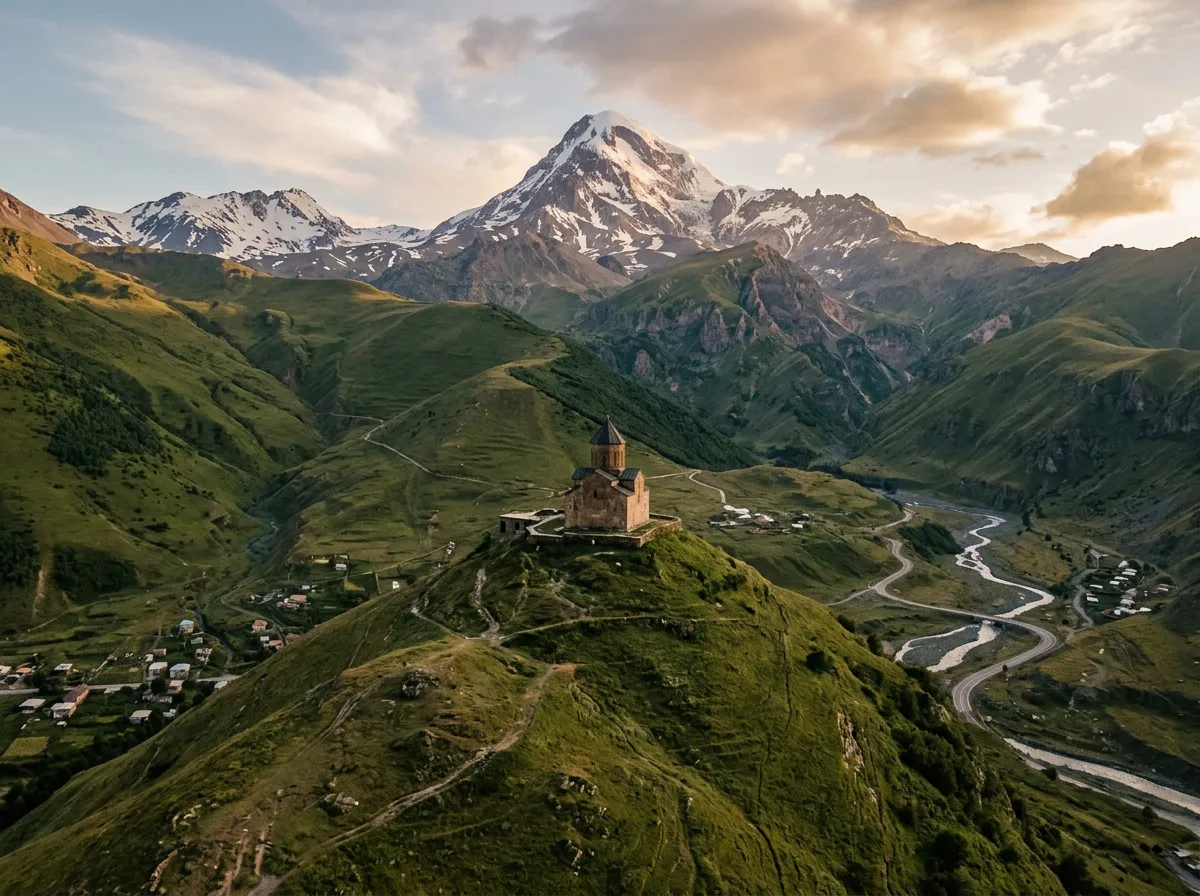
The road quality on the descent is good. The gradient is sustained but manageable, the switchbacks are wide, and the guardrails are present. The distraction is the view – Kazbek grows larger with every kilometer, and the temptation to stare at it instead of the road is real. Pull over. There are multiple viewpoints with parking. Look at the mountain properly. Then drive.
Stepantsminda (Kazbegi) sits at the base of the mountain at 1,740 meters. The town is small but well set up for tourists: guesthouses, restaurants, and drivers with Land Cruisers who will take you up to Gergeti Trinity Church if you do not want to hike the 1.5 hours yourself.
Practical information
| Detail | Information |
|---|---|
| Opening dates | Year-round for cars (may close briefly in heavy winter snow); spring is Apr-May, best season Jun-Oct |
| Toll | None |
| Fuel | Stations in Tbilisi, Mtskheta, and Pasanauri; no fuel between Gudauri and Stepantsminda |
| Parking | Free parking at Jvari, Ananuri, Cross Pass summit, and Stepantsminda |
| Best time | June through September, morning departure for the best light on Kazbek |
| Avoid | Summer weekends (extreme traffic), winter without snow experience, mid-afternoon when tour bus traffic peaks |
| Drive time | 3-4 hours Tbilisi to Stepantsminda (including photo stops) |
Traffic
The Georgian Military Highway is the only road connection between Tbilisi and the Russian border, which means it carries significant commercial truck traffic. Cargo trucks are slow on the climbs, wide on the switchbacks, and occasionally alarming in the tunnel. On summer weekends, tourist traffic – minibuses, rental cars, and organized tours – adds to the congestion.
The solution is timing. Leave Tbilisi by 7:00 AM on a weekday and you will have relatively clear roads for the climb. By 10:00 AM the tour buses are rolling, and by noon the highway at Gudauri feels like a car park with altitude.
The Kazbegi detour: Gergeti Trinity Church
You did not drive 110 kilometers over a mountain pass to skip the most iconic view in Georgia. The Gergeti Trinity Church sits at 2,170 meters on a ridge directly below Kazbek’s summit. You can hike up (1.5 hours, steep but well-trodden) or hire a 4x4 in Stepantsminda for about 80-100 GEL round trip. The church itself is a simple 14th-century stone structure. The setting – stone walls, glaciated peak, alpine meadow, clouds below you – is one of the most remarkable places we have visited anywhere.
Car rental considerations
Cross Pass does not require anything special from a vehicle. Any rental car with functioning brakes and a serviceable engine will manage the highway. That said, the sustained gradient on both sides of the pass – averaging 8% for extended stretches – will expose any weaknesses in your vehicle’s powertrain and braking system.
A diesel with adequate torque makes the climb comfortable. A small-displacement petrol engine will work but will be working hard at altitude, particularly above 2,000 meters where the thinner air reduces engine output by roughly 10-15%. If you plan to combine Cross Pass with the Tusheti Road, rent the 4x4 you need for Tusheti and enjoy the overkill on the Military Highway – a Land Cruiser on the Cross Pass is luxury rather than necessity, but it is luxury you will appreciate.
In Tbilisi, rental prices for standard sedans start at approximately 60-80 GEL (22-30 USD) per day. For the Military Highway alone, this is entirely sufficient.
Winter driving
The Georgian Military Highway remains nominally open year-round, but winter conditions between November and March transform the drive significantly. Snow accumulates at the summit, ice forms on the tunnel sections, and the road above Gudauri can become treacherous in poor visibility. Georgian road crews maintain the highway aggressively – it is, after all, the country’s only land border crossing with Russia – but clearing after heavy snowfall takes time.
If you drive in winter: snow chains are advisable (some rental agencies provide them), the tunnel section requires extreme caution, and the summit may be under a meter of packed snow with narrowed lanes. The views of Kazbek in winter, with the peak emerging from clouds above a snow-covered landscape, are extraordinary. The driving conditions needed to reach that view are not for everyone.
Combine with nearby passes
Cross Pass is the natural starting point for exploring Georgia’s mountain roads. The full Caucasus Pass Adventure itinerary combines Cross Pass with the Tusheti Road, creating a five-day route that covers both the Greater Caucasus and its most extreme mountain track.
For a mellower extension, the Abastumani Pass in the Lesser Caucasus makes an excellent addition on the return to Tbilisi – different mountains, different vegetation, different character. Where Cross Pass is dramatic and grand, Abastumani is quiet and contemplative. Together they give you a complete picture of what Georgian mountain roads can be.