Abastumani Pass
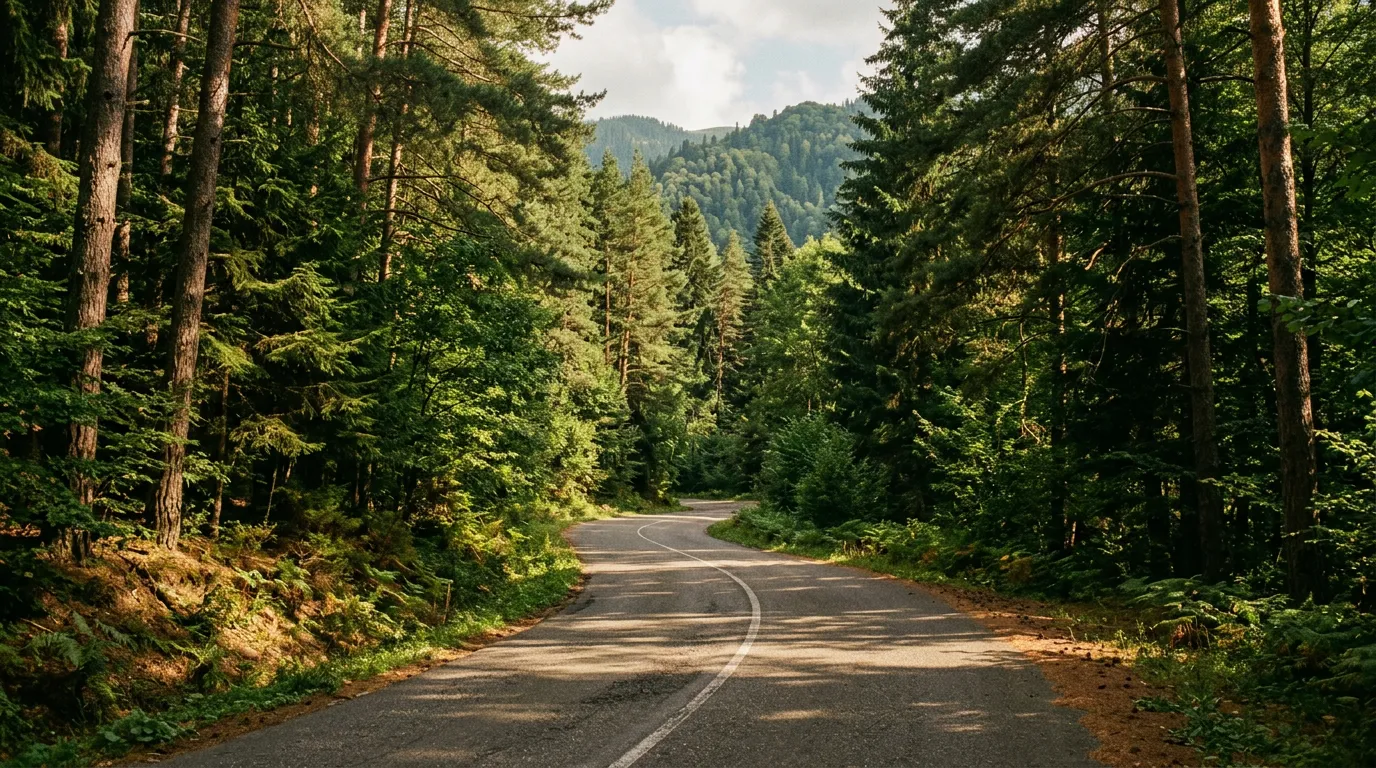
Not every mountain pass needs to terrify you. After the white-knuckle theatrics of the Tusheti Road and the grand historical sweep of the Georgian Military Highway, the Abastumani Pass offers something different: a quiet climb through dense pine forests in the Lesser Caucasus, with birdsong instead of truck horns, dappled sunlight instead of exposed cliff edges, and an astronomical observatory at the summit instead of a truck stop. This is the drive you take when you want to remember that mountain roads can be meditative.
The pass tops out at approximately 1,700 meters – modest by Caucasus standards – connecting the Akhaltsikhe valley to the old resort town of Abastumani through 35 kilometers of forested mountain road. The gradient never exceeds what a standard rental car handles comfortably. The hairpins are gentle. The worst hazard is a cow standing in the road. If you are new to Caucasus driving, or if you have just returned from Tusheti and need your nervous system to recover, this is the pass.
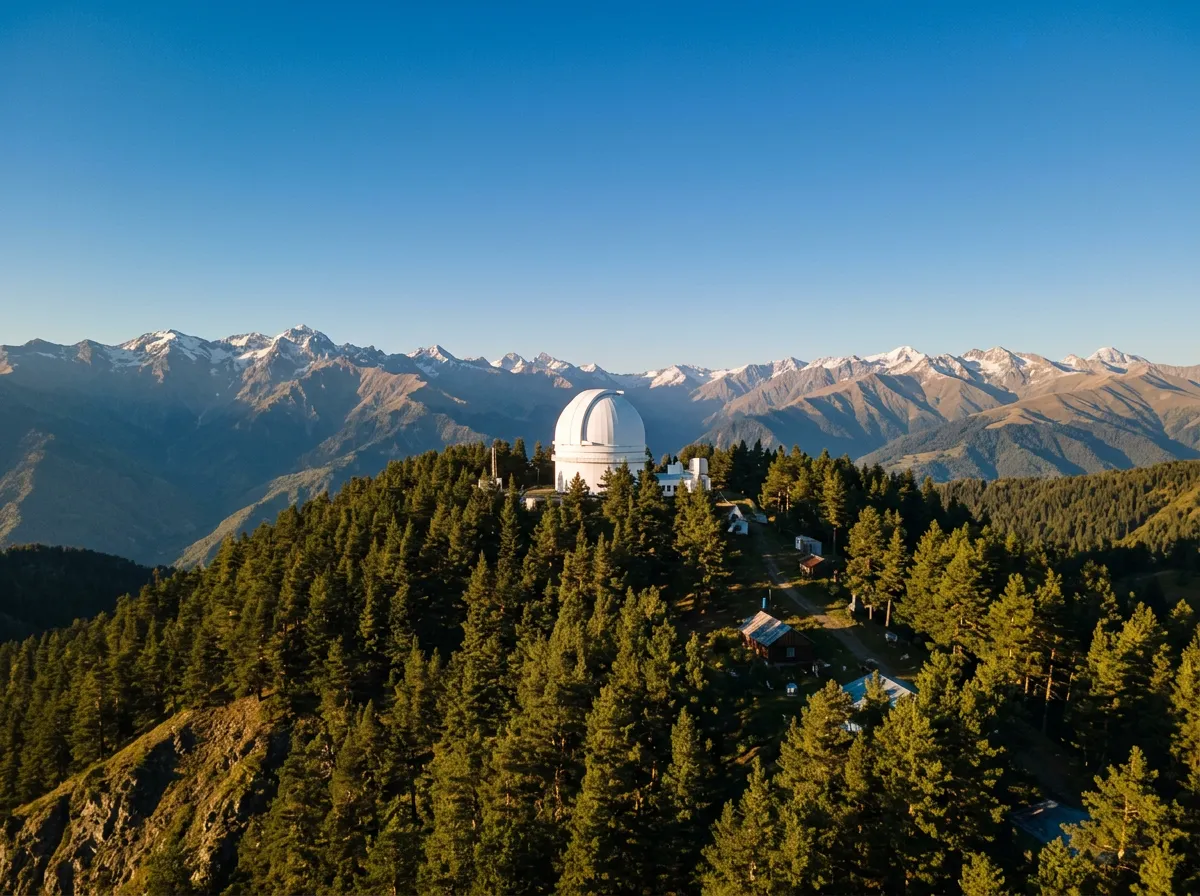
That said, modest difficulty does not mean unremarkable. The Lesser Caucasus has a character entirely distinct from the Greater Caucasus ranges to the north. These are older mountains, softer in profile, covered in forests that feel almost Central European. The light filters through pine canopies in a way that makes the road feel like a corridor through a green cathedral. And at the summit, the Abastumani Astrophysical Observatory – built in 1932 and still operational – sits at an elevation chosen specifically for the clarity of its skies. If you arrive near dusk, you can look through telescopes that have been tracking the cosmos for nearly a century.
Why drive Abastumani Pass
The Lesser Caucasus is Georgia’s overlooked mountain range. Most visitors to Georgia head north – to Kazbegi, to Svaneti, to Tusheti – where the Greater Caucasus delivers snow-capped peaks and dramatic vertical drops. The Lesser Caucasus, running along Georgia’s southwestern border with Turkey, gets almost no tourist traffic. This is partly because the peaks are lower and the landscape less dramatic in the Instagram sense, and partly because the region’s main draw – the cave city of Vardzia – can be reached without crossing any passes at all.
But driving the Abastumani Pass gives you something the northern routes cannot: solitude. In three drives over this pass, we have encountered a total of perhaps fifteen other vehicles. No tour buses. No convoys of rental cars with international plates. No truck traffic. Just forest, road, and the occasional shepherd.
The pass also serves as a historical curiosity. Abastumani was a health resort in the 19th-century Russian Empire – the dry mountain air was prescribed for tuberculosis patients, and the town developed a peculiar infrastructure of sanatoriums, bath houses, and walking paths through the forest. The observatory was added by Soviet scientists who recognized that the town’s altitude and clear skies made it ideal for astronomical observation. Today the sanatoriums are mostly ruins, the bath houses are being slowly restored, and the observatory continues to operate – a functioning scientific installation in a town that time largely forgot.
Which direction to drive
East to west – Akhaltsikhe to Abastumani. The climb is more gradual in this direction, the forest reveals itself in stages, and you arrive at the observatory and the town with the high point behind you, allowing you to explore on foot without worrying about more driving at altitude.
The reverse direction works perfectly well and has the advantage of an easier descent on the Akhaltsikhe side, where the road is wider and better maintained. If you are coming from Kutaisi or western Georgia, west to east may be the more logical routing.
Honestly, this pass is forgiving enough that direction matters less than on more technical routes. Choose whichever fits your itinerary.
One note on timing: the afternoon light on the east-to-west approach is particularly good. The sun illuminates the forest canopy from behind as you climb westward, creating the kind of backlit green glow that makes even ordinary pine trees look cinematic. If your schedule allows, cross the pass between 3:00 and 5:00 PM for the best light conditions.
Kilometer by kilometer
Km 0-10: Akhaltsikhe to the foothills
Akhaltsikhe is a small city in southwestern Georgia, best known for the restored Rabati Fortress – a sprawling complex of mosque, church, and citadel that reflects the region’s layered Ottoman, Persian, and Georgian history. The road to Abastumani heads southwest from the city through a broad agricultural valley. The surface is decent asphalt, the terrain is flat, and the driving is unremarkable. You are in the foothills of the Lesser Caucasus but would not know it yet.
Km 10-20: Entering the forest
The landscape changes as the road begins to climb. The open valley gives way to rolling hills covered in deciduous forest, which transitions quickly to dense pine as the altitude increases. The road narrows from two comfortable lanes to two narrow lanes and begins winding through the trees. The gradient is a gentle 4-6%, the curves are sweeping rather than sharp, and the surface remains asphalt – patchy in places, but never bad enough to require concern.
This is the most pleasant section of the drive. The forest is thick and old, the air noticeably cooler than the valley, and the road follows the contours of the mountainside with the kind of organic flow that suggests it was built to follow an existing path rather than engineered from surveyor’s maps. Windows down, engine at a comfortable cruise, no stress.
Km 20-30: The climb to the pass
The gradient increases to 6-8% and the first proper hairpins appear. They are wide and well-sighted – nothing that would trouble even an inexperienced mountain driver. The forest thins slightly near the summit, opening views to the south across the Lesser Caucasus ridgeline. On clear days you can see into Turkey.
The summit itself is unmarked – no monument, no parking lot, just a point where the road levels off and begins to descend. The Abastumani Observatory is accessed via a side road near the summit, and it is worth the short detour. The observatory complex includes several domed telescope buildings and a small museum. If the staff are present (they usually are during the day), they may allow you to visit the main telescope – a reflector installed in the 1970s that is still used for solar observation.
Km 30-35: Descent to Abastumani
The descent into Abastumani is short and gentle. The road drops through more pine forest into the town, which occupies a narrow valley between forested ridges. Abastumani has the faded grandeur of a once-fashionable resort: wide tree-lined avenues, crumbling stone buildings with ornate balconies, and an atmosphere of genteel decay that is either melancholy or charming depending on your disposition.
The town has a few guesthouses, a couple of restaurants, and the restored mineral baths that were its original attraction. It is a quiet place to spend a night, particularly if you plan to visit the observatory for evening stargazing sessions (available in summer by arrangement).
Practical information
| Detail | Information |
|---|---|
| Opening dates | May through October; road may be passable in April and November depending on weather |
| Toll | None |
| Fuel | Last fuel station in Akhaltsikhe; no fuel on the pass or in Abastumani |
| Parking | Free parking throughout Abastumani and at the observatory access road |
| Best time | June through September; mornings for the drive, evening for the observatory |
| Avoid | After heavy rain (patches of gravel become muddy); mid-winter (road not maintained) |
| Drive time | 45 minutes to 1 hour |
Combining with Vardzia
The cave monastery of Vardzia – Georgia’s most impressive historical site – is roughly 60 kilometers south of Akhaltsikhe along the Mtkvari River gorge. If you are driving the Abastumani Pass, combining it with a visit to Vardzia makes an excellent day trip from Akhaltsikhe. Drive to Vardzia in the morning (1 hour each way), return to Akhaltsikhe for a late lunch, then cross the Abastumani Pass in the afternoon for an evening in Abastumani. The two experiences complement each other perfectly: ancient cave city followed by astronomical observatory, human history meeting the cosmos.
Car rental and logistics
Any rental car handles the Abastumani Pass comfortably. The road is paved (if variably maintained), the gradient is moderate, and ground clearance is not a concern. If you are renting specifically for this pass, a standard sedan is fine. If you are renting for a broader Georgian trip that includes the Tusheti Road, you already have more car than you need here.
Akhaltsikhe has limited rental options – most visitors rent in Tbilisi (3 hours away by highway) and drive to the region. The road from Tbilisi to Akhaltsikhe via Borjomi passes through the spa town and its surrounding forests, which makes a pleasant half-day drive in itself.
Fuel is available in Akhaltsikhe but not on the pass or in Abastumani. The total fuel consumption for the 35-kilometer crossing is minimal – even the thirstiest rental car will use less than 5 liters. But if you are continuing west from Abastumani toward Kutaisi, the next fuel station is roughly 80 kilometers away in the valley, so fill up in Akhaltsikhe before crossing.
The observatory at night
If your schedule allows an overnight in Abastumani, inquire locally about evening observation sessions at the Astrophysical Observatory. The facility hosts occasional public viewing nights during summer, using telescopes that have been in continuous operation since the Soviet era. The altitude and clear mountain air provide excellent seeing conditions – the same characteristics that led Soviet astronomers to establish the observatory here in 1932.
The experience of looking at Saturn’s rings through a 70-year-old telescope while standing at 1,700 meters in the Georgian mountains is, by any measure, worth the slight logistical effort of arranging it. Contact the observatory in advance through guesthouses in Abastumani – the staff are scientists, not tour operators, and advance notice helps.
Combine with nearby passes
The Abastumani Pass works best as a complement to Georgia’s more demanding mountain roads. If you are planning the full Caucasus Pass Adventure, consider driving Abastumani before heading north to the Greater Caucasus – it serves as an acclimatization drive, getting you comfortable with Georgian road conditions, Georgian driving customs, and Georgian cows before the stakes get higher.
From Abastumani, you can loop back to Tbilisi via Kutaisi and the central highway, positioning yourself for the Georgian Military Highway heading north. Or continue south to explore the Turkish border region, where the Lesser Caucasus continues into the Kaçkar Mountains and connects (eventually, with considerable effort) to Turkey’s own mountain pass system.
The Abastumani Pass will not make your palms sweat. It will not test your courage or your brakes. What it will do is remind you that mountain driving is not always about adrenaline. Sometimes it is about pine trees, quiet roads, and a telescope pointed at the stars.