Iceland Highland Roads Guide
Here is a true story. A couple from the Netherlands rented a Hyundai i20 at Keflavik Airport, drove it onto F-road 35 because the GPS said it was the shortest route to Landmannalaugar, and discovered — approximately eight hundred meters past the “Unsuitable for 2WD Vehicles” sign that they had chosen to interpret as a suggestion — that the Hyundai i20 does not ford rivers. They stood on the bank of a shin-deep glacial stream and watched their car settle into the gravel bed with the quiet dignity of a ship accepting its fate. The rescue cost more than the car. We know this because we were the second car in the queue, waiting in our rented Dacia Duster, which also could not ford the river but at least had the excuse of being a crossover with delusions of capability.
Iceland’s highland roads are not a mild variation on normal driving. They are a different activity entirely, governed by different rules, requiring different vehicles, and punishing different mistakes. This guide exists because the line between “dramatic adventure” and “expensive catastrophe” in the Icelandic highlands is precisely one poor decision wide.
What is an F-road
F-roads (fjallvegir, literally “mountain roads”) are Iceland’s highland tracks. They are designated with an F prefix — F26, F35, F88, and so on — and they share several characteristics that distinguish them from Iceland’s numbered routes:
| Feature | Numbered routes (1-99) | F-roads |
|---|---|---|
| Surface | Asphalt or maintained gravel | Unmaintained gravel, rock, sand |
| River crossings | Bridges | You drive through the river |
| Season | Most open year-round | Late June to early September only |
| 2WD allowed | Yes | No (legally prohibited for standard cars) |
| Mobile coverage | Usually available | Rarely available |
| Rescue response time | 30-60 minutes | 2-8 hours, potentially longer |
The F-road designation is a legal classification, not merely a condition report. Driving a non-4WD vehicle on an F-road is a traffic violation. More importantly, if you damage a 2WD rental car on an F-road, your insurance is void. Every policy, every agency, no exceptions. The rental companies are not being difficult — they are being accurate about what their vehicles can handle.
F-road vs. numbered gravel roads
This is where confusion sets in, because not all challenging roads in Iceland are F-roads, and not all F-roads are equally challenging.
Some numbered routes — particularly in the Westfjords — are gravel roads that rival F-roads for difficulty. Route 60 crosses heath passes at 500-600 meters on loose gravel with no guardrails, and it is absolutely not an F-road. It is a numbered route that happens to be terrible. A 4WD is strongly recommended but not legally required.
Conversely, F-road 35 (Kjolur route) is one of the more moderate highland tracks — mostly flat, no river crossings, compacted gravel. It still requires 4WD by law, and the surface still deteriorates into washboard corrugation that feels like driving over a giant cheese grater, but it is not the life-threatening adventure that some F-roads represent.
The key distinction:
| Road type | Legal requirement | Practical requirement |
|---|---|---|
| Numbered route (gravel) | Any vehicle | 4WD strongly recommended on many |
| F-road (no river crossings) | 4WD required by law | 4WD with good clearance |
| F-road (with river crossings) | 4WD required by law | Modified 4WD with snorkel recommended |
Which passes and roads need 4x4
We break Iceland’s mountain driving into three tiers. Know which tier you are entering before you leave the last fuel station.
Tier 1: Standard car acceptable (with caution)
These are paved or well-maintained gravel roads that a competent driver in a standard rental car can handle in good weather:
- Route 1 (Ring Road): Fully paved. The baseline.
- Route 54 (Snaefellsnes): Paved throughout.
- Route 939 (Fjaroarheioi): Paved mountain pass in East Iceland. Steep but manageable.
- Westfjords coastal roads (Routes 61, 65, 68): Mostly paved, some gravel sections.
Tier 2: 4WD strongly recommended
Gravel roads that are legally open to all vehicles but where 2WD is a genuine liability:
- Route 60 (Westfjords passes): Loose gravel, steep gradients, single-lane. See our Westfjords Passes guide.
- Route 622 (Latrabjarg): Gravel road to Europe’s westernmost point. Poor surface, exposed.
- Route 917 (Borgarfjordur Eystri): Gravel road in the East. Single-lane with blind summits.
- Route 94 (to Borgarfjordur Eystri): Mountain section with steep gravel grades.
Tier 3: 4WD required (F-roads)
These are the highland tracks. 4WD is a legal requirement.
- F35 (Kjolur): The gentlest F-road. No river crossings. Flat highland plateau. A good introduction.
- F26 (Sprengisandur): Longer, more remote. Some shallow stream crossings. Black sand desert.
- F208 (to Landmannalaugar from south): River crossings required. Beautiful rhyolite mountains.
- F88 (to Askja): Multiple river crossings, some deep. Remote volcanic landscape.
- F578 (to Arnarvatnsheioi): Lake district highland. Moderate difficulty.
- F249 (Thorsmork): River crossings that can be impassable. Water depth changes hourly with glacial melt.
- F210 (Fjallabak): Serious river crossings. Modified vehicles recommended.
The “superjeep” roads
Some tracks require vehicles with raised suspension, oversized tires, and snorkels:
- F910 (to Askja via Vonarskaroi): Extreme. Not a road in any conventional sense.
- Rivers on F249 in peak glacial melt: Can exceed 80cm depth. Standard SUVs cannot pass.
River crossings
River crossings are the defining challenge of Icelandic highland driving, and they deserve more respect than most drivers give them.
The rules
-
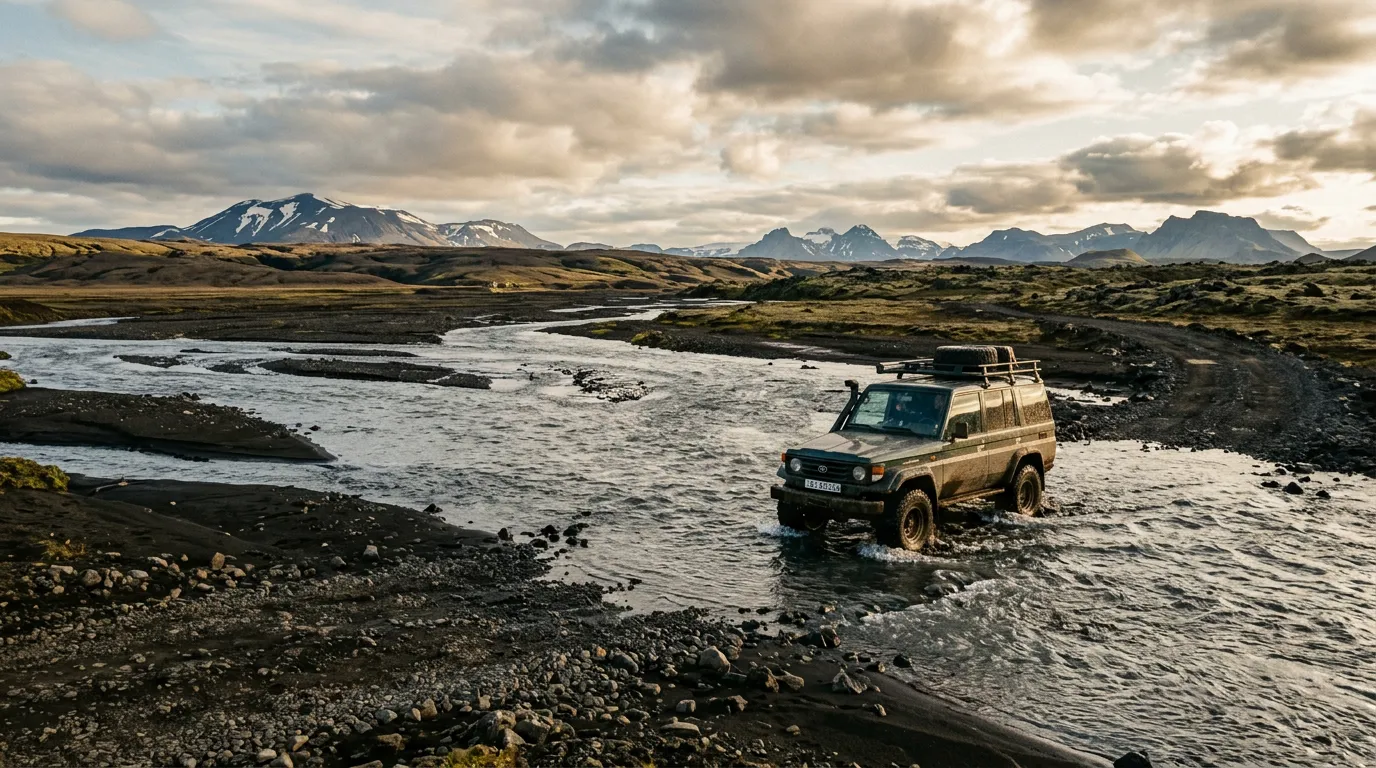
Never cross a river you have not walked first. Get out of the car. Wade in. Check depth, current, and bottom surface. We carry neoprene wading boots for this purpose. You will look ridiculous. You will also not drown your engine.
-
Cross where the river is widest, not narrowest. Wide sections are shallower. Narrow sections concentrate the current.
-
Face upstream. Angle the car slightly into the current so water hits the front quarter rather than the side. Side-on current pushes water into the door seals and can push the car downstream.
-
Steady speed, low gear. Enter slowly, maintain momentum, do not stop. Second gear, low range if available. Create a bow wave that pushes water away from the engine bay.
-
Know your vehicle’s wading depth. A stock Dacia Duster: roughly 40cm. A Toyota Land Cruiser 70: 70cm. A modified superjeep: 100cm+. The river does not care what your marketing brochure says.
-
Glacial rivers rise in the afternoon. Meltwater peaks between 2 PM and 6 PM. A crossing that was 30cm at 8 AM may be 60cm by 4 PM. Plan accordingly.
What happens if you get it wrong
The water enters through the door seals first. Then through the air intake. If water reaches the air intake while the engine is running, you achieve hydrostatic lock — the engine attempts to compress water, which does not compress, and the connecting rods bend or the engine block cracks. This is not a repair. This is a new engine. In a rental car in the Icelandic highlands, the cost starts at two thousand euros and climbs rapidly from there.
The other failure mode is simpler: the current pushes the car off the crossing line and into deeper water. The car fills. You evacuate. The car stays in the river until a rescue truck extracts it, which takes hours and costs the kind of money that makes you reassess your definition of “expensive.”
We have seen both happen. Neither is entertaining to witness.
Rental restrictions and insurance
Every rental agency in Iceland has specific policies about highland driving. These policies are not suggestions.
| Policy | Typical terms |
|---|---|
| F-roads in a 2WD car | Prohibited. Insurance void. Full damage liability on you. |
| F-roads in a standard 4WD (Duster, Tucson, etc.) | Usually permitted on “easy” F-roads (F35, F550). Prohibited on river-crossing F-roads. |
| River crossings | Many agencies prohibit all river crossings regardless of vehicle. Read the contract. |
| Gravel damage (windshield, underbody) | Usually excluded from standard insurance. Buy gravel protection (SAAP/GP). |
| Sand/ash damage | Excluded from all policies. Volcanic sand strips paint. |
| Off-road driving (outside marked tracks) | Illegal in Iceland. Massive fines. Environmental damage permanent. |
The practical advice: if you plan to drive F-roads with river crossings, rent from an agency that specializes in highland vehicles (Arctic Trucks, Lotus Car Rental, Go Iceland). The vehicles are more expensive — 200-350 EUR/day for a proper highland 4WD — but the insurance actually covers what you are doing.
The highland season
The Icelandic highlands have a driving season measured in weeks, not months.
| Month | Conditions |
|---|---|
| May | All F-roads closed. Snow on highlands. Do not attempt. |
| Early June | Most F-roads still closed. Some open toward end of month. Check road.is daily. |
| Late June | F35, F550 typically open. Others variable. River levels high from snowmelt. |
| July | Most F-roads open. Best overall conditions. Rivers still significant. |
| August | Peak season. Roads at their best. Rivers lower. Weather more stable (relatively). |
| Early September | Some F-roads begin closing. Weather deteriorates. Days shorten noticeably. |
| Late September | Most F-roads closed. Snow returns to highlands. Season effectively over. |
| October-April | Everything closed. Snow, ice, darkness. Not a discussion. |
The official road status page — road.is — updates daily during the season. A green dot means open. A yellow dot means passable with caution. A red dot means closed. Do not argue with the dots.
Essential equipment for highland driving
| Item | Why |
|---|---|
| Full-size spare tire | Not a space-saver. A full-size spare. Highland gravel eats tires. |
| Tire pressure gauge and pump | Lower pressure on gravel (1.8-2.0 bar), re-inflate for asphalt. |
| Tow rope | You will either need one or someone else will need yours. |
| Wading boots or neoprene shoes | For checking river depths before crossing. |
| Satellite communicator (InReach, SPOT) | No mobile coverage on most F-roads. 112 Iceland app helps but requires signal. |
| Physical map | GPS databases are incomplete for highland tracks. Download offline maps before departure. |
| Extra fuel | Some F-road stretches exceed 200km between fuel stations. Carry at least 10L extra. |
| Food and water | Enough for 24 hours. If you break down, help is not immediate. |
Common mistakes
We have watched people make every one of these mistakes. Some of them we made ourselves.
Trusting the GPS. Google Maps and Waze do not understand F-roads. They will route you onto tracks that require a superjeep, because to an algorithm, a shorter distance is a better distance. Use the dedicated Iceland road map (ferdakort.is) or Gaia GPS with the Iceland overlay.
Crossing rivers without checking. We said it above but it bears repetition. Get out of the car. Every single time.
Driving at pavement speed on gravel. The speed limit on gravel roads is 80 km/h. The safe speed is often 40-50 km/h. The difference is the distance between maintaining control and discovering that your car becomes a projectile when the gravel transitions from compacted to loose.
Ignoring weather forecasts. A highland trip planned on Monday should be reconfirmed on Tuesday morning. Weather changes in the highlands are not gradual — they are sudden, dramatic, and dangerous. Wind that is manageable at sea level becomes violent at 600 meters.
Assuming the rental car’s capabilities. A Dacia Duster is not a Land Cruiser. A Suzuki Jimny has excellent ground clearance but terrible stability in crosswinds. A Toyota RAV4 is a suburb car with aspirations. Know what your vehicle can actually do, not what the category name implies.
The highland passes
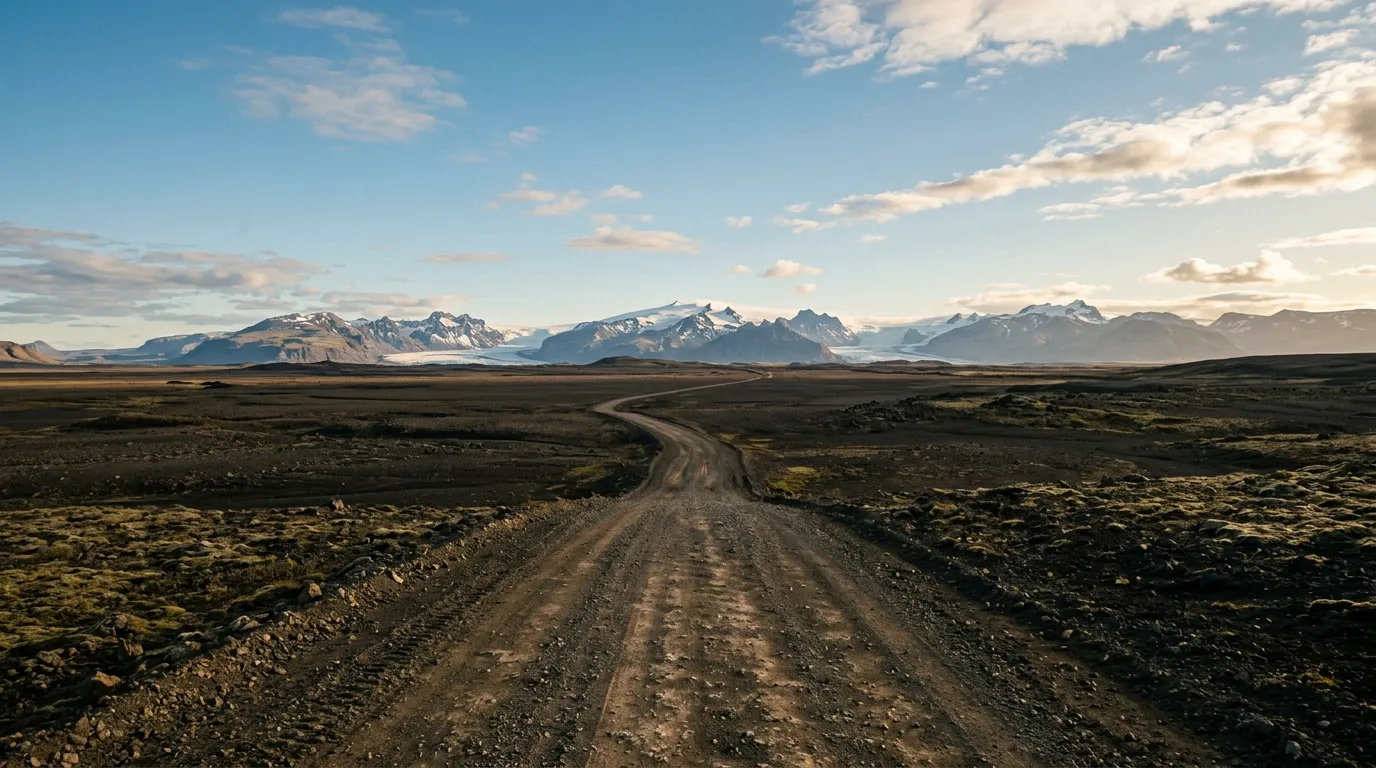
Iceland does not have mountain passes in the Alpine sense — numbered hairpins climbing to a photogenic summit with a restaurant. What it has is road segments that cross elevated terrain between lowland areas, gaining altitude through exposed plateaus rather than switchback engineering.
The highest point accessible by standard road is Hringvegur near Oxnadalur in North Iceland, at roughly 540 meters on paved Route 1. The highest F-road points reach approximately 800-900 meters on the interior plateau.
The challenge is never the altitude. It is the conditions at altitude: wind, visibility, surface quality, and the absolute certainty that if something goes wrong at 700 meters on F26, the nearest help is two hours away on a good day.
For the most accessible mountain pass experience in Iceland — genuine elevation change, gravel surface, coastal drama — the Westfjords Passes are the best option. They are not F-roads, they do not require river crossings, and they deliver the isolation and scenery that makes Icelandic mountain driving unique. See also our Westfjords Circuit for a multi-day itinerary.
Iceland’s highlands are not the place to discover what 4WD means or to learn how deep a river is by driving into it. They are the place to apply skills and equipment you already have. The landscape is generous with its beauty and absolutely merciless with its consequences. Respect the distinction and you will have the drive of your life. Ignore it and you will have a very expensive story to tell at the rental return desk.