Julian Alps Pass Loop
The Julian Alps are the smallest major Alpine range and, by any reasonable metric, the most densely packed with interesting driving. In the Swiss Alps, you need three hours of valley driving to connect two significant passes. In the Julian Alps, you need forty minutes. The entire range fits inside a rectangle that would not quite cover the canton of Uri. Within that rectangle, there are three mountain roads worth building a trip around — and all three can be driven from a single base in two days.
This loop uses Bovec as its center. You arrive, you drive the Vrsic Pass from the north and descend into the Soca valley. You drive the Mangrt Road up to 2,055 meters and back down. You cross the Predel Pass to the Italian border and return. Then you have a beer in Bovec and try to decide which of the three was your favorite, which is a conversation that has no correct answer and no natural conclusion.
Route overview
| Day | Route | Pass | Elevation | Distance | Drive time |
|---|---|---|---|---|---|
| 1 | Kranjska Gora — Vrsic summit — Trenta — Bovec | Vrsic Pass | 1,611m | 50km | 2-3 hours |
| 1 (afternoon) | Bovec — Predel Pass — Italy border — Bovec | Predel Pass | 1,156m | 30km return | 1-1.5 hours |
| 2 | Bovec — Log pod Mangartom — Mangrt Saddle — return | Mangrt Road | 2,055m | 40km return | 2.5-3.5 hours |
Total: approximately 120km and 6-8 hours of driving across two days. The distances are short. The intensity is not.
This is a compact circuit where the drive time is measured not in distance but in concentration. The Vrsic has 50 cobblestone hairpins. The Mangrt has single-lane tunnels blasted from raw rock. The Predel is a palate cleanser — a gentle border crossing through mountain meadow that lets your heart rate return to baseline.
Day 1, morning: Vrsic Pass (Kranjska Gora to Bovec)
| Distance: 50km | Drive time: 2-3 hours | Difficulty: 3/5 |
Getting to the start
If you are arriving from Austria (Villach/Tarvisio direction), Kranjska Gora is directly accessible via the Karawanken Tunnel. From Ljubljana, it is approximately 90 minutes on the motorway to Jesenice and then the short hop to Kranjska Gora. From Italy, the Predel or Nevea passes bring you to the Soca valley, and you would start the loop from the Bovec end.
Kranjska Gora has ample fuel, accommodation, and supplies. Fill the tank, eat breakfast, and head south.
The crossing
The Vrsic Pass is detailed in its own guide, but the essentials: 24 numbered hairpins on the northern ascent, many on original cobblestone. The climb from 800 meters to the 1,611-meter summit is steep, technical, and historically resonant — the road was built by Russian POWs in World War I, and the Russian Chapel at hairpin 8 is a mandatory stop.
The summit provides Julian Alps panorama and a mountain hut for coffee. The southern descent adds another 26 hairpins, this time predominantly on asphalt, with views down the Trenta valley toward the Soca River. The descent ends in Trenta, from where a 13-kilometer valley road brings you to Bovec.
Arrive in Bovec by early afternoon. Check into accommodation, eat lunch, and prepare for the afternoon drive.
Key stops on the Vrsic
| Stop | Location | Time needed |
|---|---|---|
| Russian Chapel | Hairpin 8 (north side) | 15 minutes |
| Summit viewpoint | 1,611m | 20-30 minutes |
| Soca River source | Southern descent, signed | 30 minutes |
Day 1, afternoon: Predel Pass (Bovec to Italy and back)
| Distance: 30km return | Drive time: 1-1.5 hours | Difficulty: 1/5 |
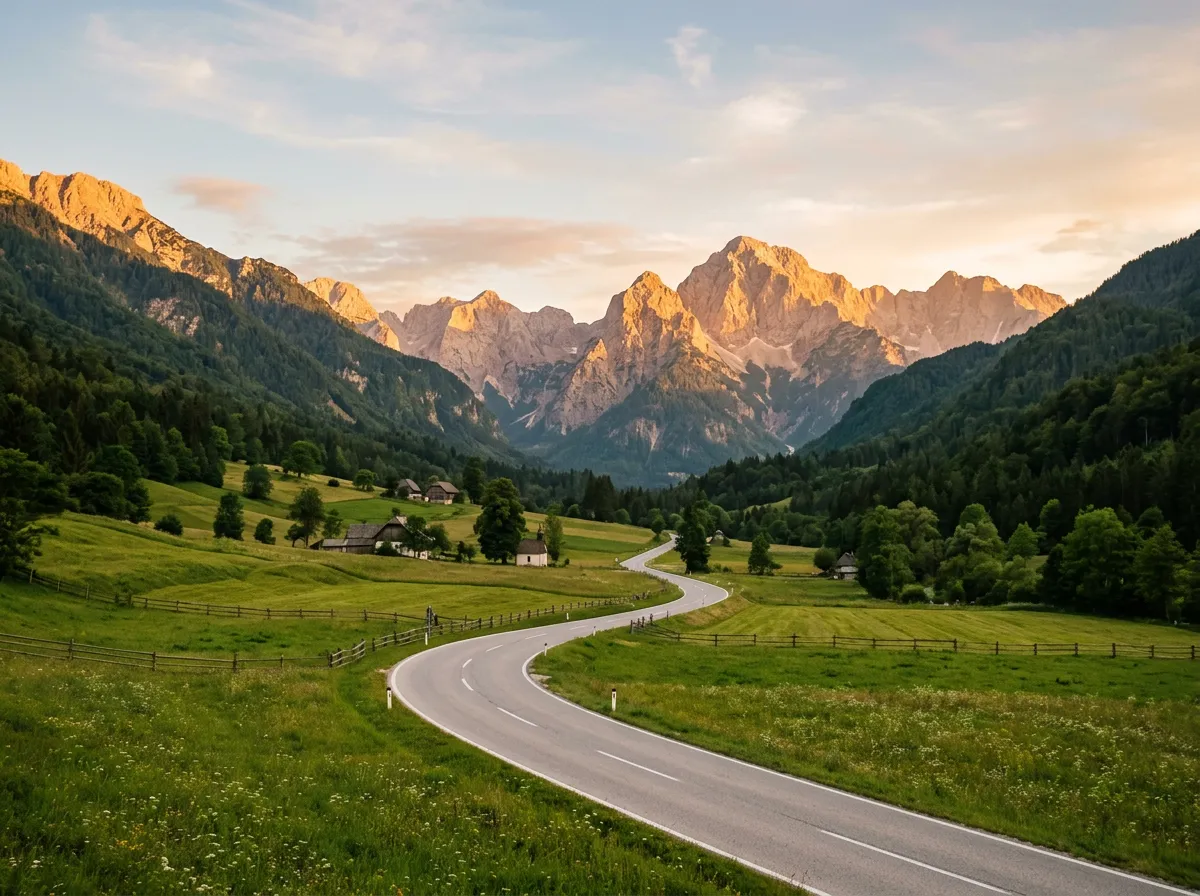
The Predel Pass is the loop’s gentle member. It crosses the Julian Alps at 1,156 meters on a two-lane road with gradual gradients, good asphalt, and views of alpine meadow that look like a screensaver designed by someone with excellent taste.
The route
From Bovec, drive northwest on the road toward Log pod Mangartom (this is the same valley that accesses the Mangrt Road — you will return here tomorrow). At Log pod Mangartom, the road to the Predel continues north toward the Italian border. The climb is gentle — 6-7% gradient, wide curves, comfortable in any vehicle.
The border crossing is unmarked — Slovenia and Italy are both Schengen states. You cross from one country to another with no ceremony whatsoever, which somehow makes the geographic significance of the pass more rather than less impressive. Mountains do not care about borders.
On the Italian side, the road descends toward the Val Canale and the Tarvisio junction. You can continue to Tarvisio for Italian coffee (the quality improvement over Slovenian gas station coffee is measurable), or turn around at the border and return to Bovec.
Why include Predel
Predel is not a destination drive. It is a context drive. After the intensity of the Vrsic, driving a gentle, beautiful mountain road at a comfortable pace recalibrates your nervous system. It also puts you on the road to the Mangrt junction, so you can preview the approach for tomorrow’s main event.
The late afternoon light in the Koritnica valley, with the Julian Alps peaks catching the last sun, is excellent. This is the drive where you roll the windows down and enjoy the road rather than concentrate on it.
Day 2: Mangrt Road (Bovec to 2,055m and back)
| Distance: 40km return | Drive time: 2.5-3.5 hours | Difficulty: 4/5 |
This is the loop’s climax. Start early — 7:30 or 8:00 AM — for two reasons. First, the Mangrt Road is single-lane for its upper half, and early morning minimizes the chance of meeting oncoming traffic in the tunnels. Second, mountain fog typically builds from mid-morning, and the Mangrt’s panoramic views require clear air to justify the effort.
The ascent
From Bovec, drive 20 minutes northwest to Log pod Mangartom and the signed Mangrt junction. The toll barrier (approximately 5 EUR) marks the beginning of the Mangrt Road.
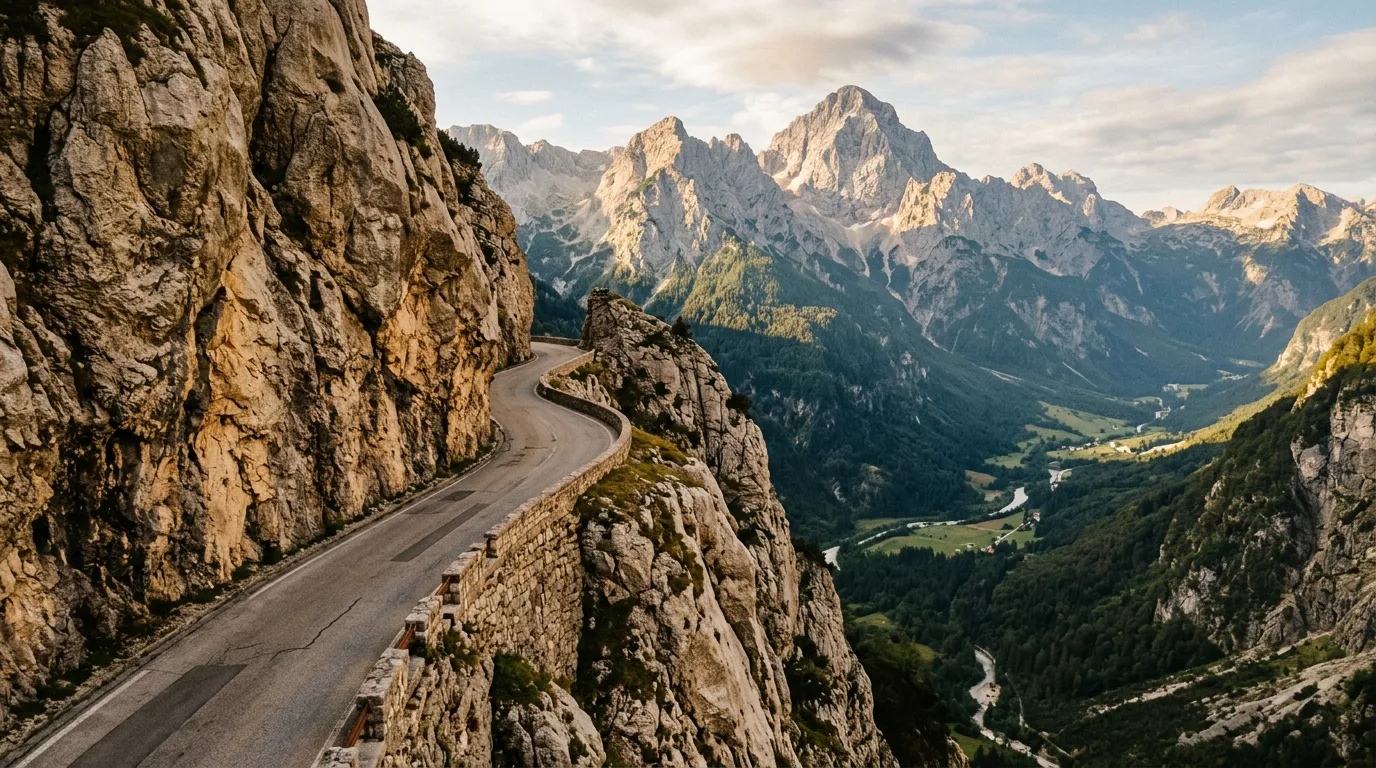
The Mangrt Road has its own detailed guide, but the summary: twelve kilometers of progressively more demanding road, from two-lane asphalt through single-lane tunnel to exposed mountain traverse. The tunnels, carved from raw limestone in the 1930s by the Italian military, are the crux — unlit, unlined, barely car-width. The upper traverse has minimal guardrails and significant exposure. The summit parking at the Mangrt Saddle (2,055m) is the highest point reachable by car in Slovenia.
At the top
The Mangrt Saddle parking area is small and exposed. A mountain hut (Koca na Mangrtskem sedlu) operates in summer, and hiking trails lead toward the Mangrt summit and the Italian ridge. On clear days, the view extends from the Dolomites to the Adriatic haze.
Allow 30-45 minutes at the top. Photograph the view. Let the brakes cool. Accept that you need to descend the same road.
The descent
The descent takes longer than the ascent. The tunnels are more stressful downhill (braking on uncertain surface in darkness), and the exposed traverse sections feel more precipitous when you can see the drop while braking rather than climbing away from it.
The established convention is that descending vehicles yield to ascending vehicles in the tunnels, because ascending vehicles have better visibility. In practice, whoever sees the other vehicle first should stop and communicate. Flash headlights. Sound the horn. Be patient. Reversing in the tunnels is slow and best avoided — if you can pull into a widened section, do so.
Arrive back at the junction by late morning. Return to Bovec for a well-earned lunch and a moment of reflection on the fact that a twelve-kilometer dead-end road in a small Alpine country has just delivered one of the most memorable driving experiences of your life.
Bovec as a base
Bovec is a small town (population ~1,700) in the upper Soca valley that punches above its weight as an adventure tourism hub. In summer, the town is oriented toward hiking, kayaking, and canyoning on the Soca River. For drivers, it provides the perfect base: central location, reliable services, and easy access to all three passes.
| Service | Details |
|---|---|
| Fuel | Petrol station on the main road through town. Open daily. |
| Accommodation | Hotels, guesthouses, apartments, and a campsite. Book ahead Jul-Aug. |
| Dining | Several restaurants specializing in Soca trout and local cuisine. Quality is high. |
| Supermarket | Mercator on the main road. Adequate for provisions. |
| Parking | Free street parking. Most accommodations include parking. |
| Activities | Soca kayaking, canyoning, zip-lining, hiking. If you have a rest day, the river is spectacular. |
The Soca River itself is worth mentioning. The water is a shade of turquoise that photographs fail to capture accurately — it looks filtered, enhanced, unreal. It is not. The color comes from glacial flour suspended in limestone-filtered water, and it is genuinely that blue. If you have time between passes, a Soca kayaking trip is an excellent use of a half-day.
Which car to rent
This circuit’s demands are set by the Mangrt Road, which is the most restrictive element.
| Factor | Requirement |
|---|---|
| Width | Under 1.9m strongly recommended. The Mangrt tunnels punish wide vehicles. |
| Length | Standard car fine. Nothing over 5m. |
| Power | 100+ HP adequate. The gradients are not extreme; the difficulty is technical, not power-related. |
| Transmission | Manual preferred for cobblestones (Vrsic) and tunnel control (Mangrt). Automatic fine if comfortable. |
| Ground clearance | Standard adequate. The Mangrt’s upper gravel sections benefit from slightly more. |
| Mirrors | Power-folding mirrors are a genuine advantage on the Mangrt. If manual, practice folding them. |
Rent in Ljubljana or Villach (Austria) for best availability. Kranjska Gora and Bovec have limited rental options. If renting from a Slovenian agency, verify that the policy permits mountain pass driving — some exclude gravel sections.
Practical information
| Detail | Information |
|---|---|
| Total distance | ~120km across two days |
| Total drive time | 6-8 hours (concentrated) |
| Best months | July-September for all three passes open. June and October possible but check Mangrt. |
| Fuel planning | Fill in Kranjska Gora or Bovec. No fuel on any pass. Maximum gap: ~50km (Kranjska Gora to Bovec via Vrsic). |
| Accommodation | Bovec is the base. Book ahead in summer. |
| Weather | Julian Alps generate afternoon cloud/rain. Morning drives recommended for both passes. |
| Cost | Mangrt toll ~5 EUR. Vrsic free. Predel free. Fuel and accommodation are the main costs. |
| Toll stickers | Slovenia requires a vignette (e-vinjeta) for motorways. Not needed for the pass roads themselves. |
| Emergency | 112. Mountain rescue available but response times to upper Mangrt significant. |
Individual pass guides
- Vrsic Pass — 50 numbered hairpins, cobblestone, 1,611m, difficulty 3
- Mangrt Road — single-lane tunnels, dead-end, 2,055m, difficulty 4
Two days, three passes, 120 kilometers. The distances are almost embarrassingly short for a driving itinerary. In most countries, 120 kilometers is a morning commute. In the Julian Alps, 120 kilometers contains fifty cobblestone hairpins, two rock tunnels, one international border crossing, and a dead-end road to the highest point in Slovenia. We have driven itineraries ten times this length that contained half the driving interest. The Julian Alps do not waste your kilometers.