Vrsic Pass
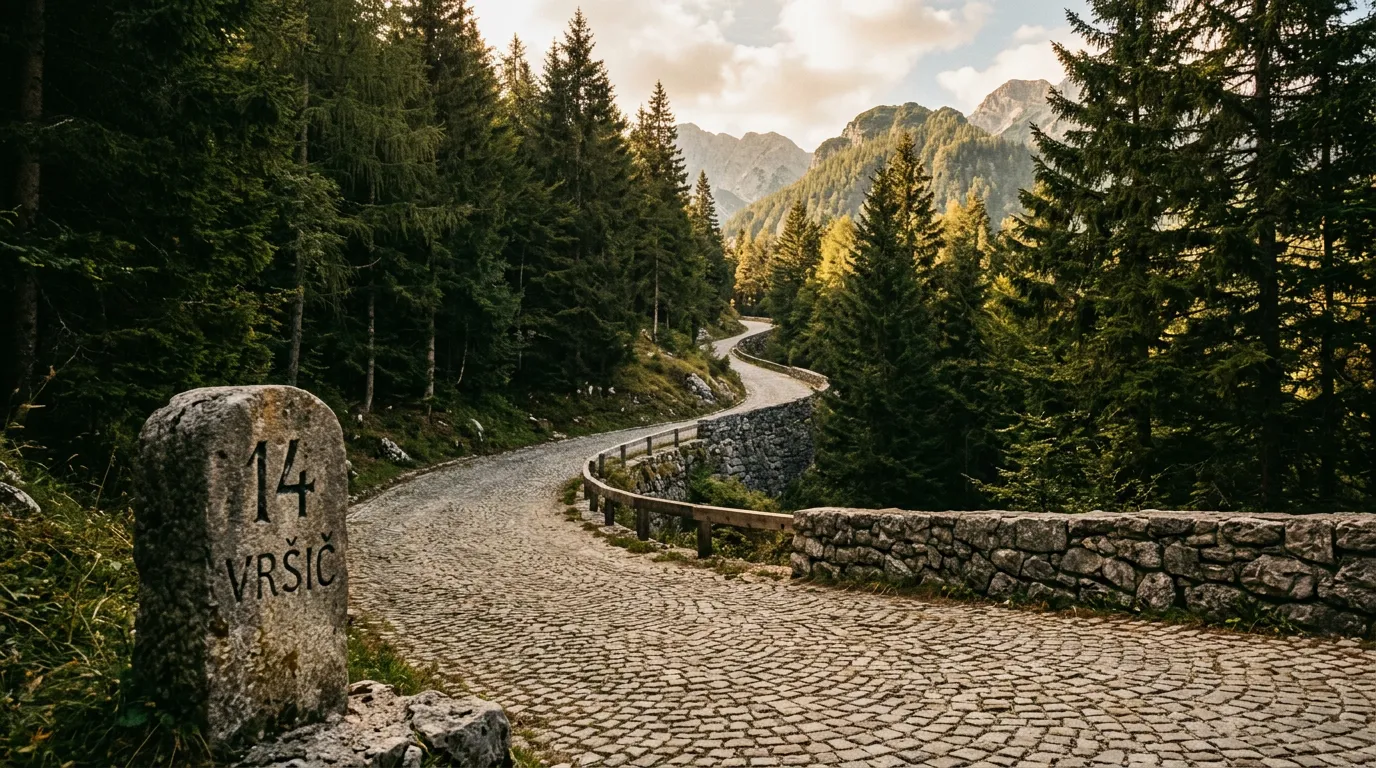
Fifty hairpins. Each one numbered. Each number carved into a stone marker planted at the apex, counting upward from 1 to 24 on the northern ascent and back down from 1 to 26 on the southern descent. The engineering is Slovenian. The numbering system is obsessive. We approve on both counts.
The Vrsic Pass climbs to 1,611 meters through the Julian Alps on a road that was built in 1915-1916 by Russian prisoners of war, and that origin story is not a footnote — it is written into the surface of the road itself. Many of the original hairpins retain their cobblestone paving, rough-cut blocks of limestone laid by hand over a century ago, and driving over them sends a vibration through the car that connects you physically to the people who built this road. Some of them died building it. An avalanche in March 1916 killed between 100 and 300 Russian prisoners in a single event. The Russian Chapel, built by the surviving prisoners near hairpin 8, stands as a memorial. You will pass it. You should stop.
Why drive Vrsic Pass
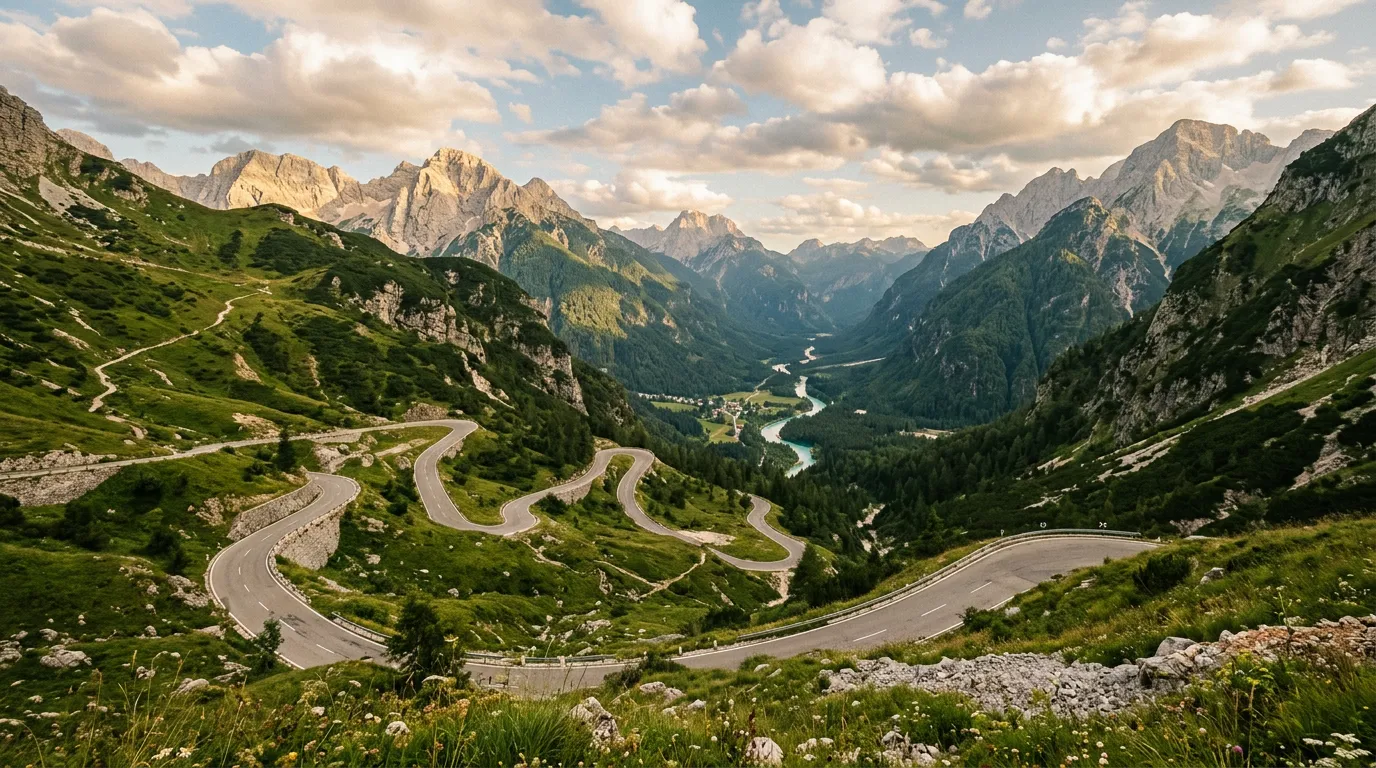
The Vrsic is the highest paved pass in Slovenia and the centerpiece of the Julian Alps driving experience. It connects Kranjska Gora in the north with the Soca valley in the south, and the transition between these two valleys is one of the most satisfying in Alpine driving. The north side is steep, forested, and tight — cobblestone hairpins through spruce forest, the kind of driving where second gear is aspirational and first is realistic. The south side opens into broader curves with views down the Trenta valley toward the emerald Soca River, and the character shifts from technical challenge to scenic reward.
What distinguishes the Vrsic from comparable Alpine passes is the texture. Swiss passes are engineered to perfection — smooth asphalt, calculated radii, everything optimized. The Vrsic retains the character of its construction: cobblestones that are uneven, hairpins that are tighter than modern standards would allow, a road width that was designed for horse-drawn military supply wagons rather than German tour buses. The imperfection is the appeal.
The numbered hairpins add a gamification element that we did not expect to enjoy but absolutely did. Each stone marker is a checkpoint, a small confirmation of progress, and by hairpin 18 on the northern ascent you are invested in the count the way a child is invested in a countdown. Hairpin 24 arrives with a satisfaction that is disproportionate to its objective significance.
The Vrsic is also the gateway to the Julian Alps Pass Loop, a two-day circuit that chains the Vrsic with Mangrt Road and Predel Pass. The loop uses Bovec as a base, and the Vrsic is its northern leg.
Which direction to drive
North to south. Start from Kranjska Gora.
The northern ascent has 24 hairpins. The southern descent has 26. The northern hairpins are tighter, steeper, and more cobblestoned. You want to climb these, not descend them. Climbing cobblestones at low speed in a low gear is engaging. Descending cobblestones while braking is unpleasant — the surface provides less grip than asphalt, the vibration makes precise brake modulation harder, and the combination creates a jerky, uncomfortable descent that is hard on both the car and your passengers.
The south side, with its wider curves and better sightlines, makes a natural descent. The Trenta valley unfolds below you as you drop, and the views toward the Soca improve with each hairpin. This is the reward for the effort of the northern climb.
The practical argument reinforces the aesthetic one. Kranjska Gora has better infrastructure — more accommodation, more dining options, easier access from the Austrian and Italian motorway networks. Starting here means a comfortable base and a settled breakfast before the climb. Ending in the Soca valley puts you in position for Bovec, the Mangrt Road, or the Predel Pass toward Italy.
Kilometer by kilometer
Km 0-3: Kranjska Gora to the forest
The road leaves Kranjska Gora heading south, passing the last fuel station and entering the forest almost immediately. The first three hairpins (numbered 1-3) are wide, asphalt-surfaced, and gentle — a warm-up that lulls you into underestimating what follows.
The gradient steepens quickly. By hairpin 4, the asphalt transitions to cobblestone, and the road narrows from two comfortable lanes to approximately one and a half. The forest closes in — dense spruce that filters the light and creates a shadowy, enclosed atmosphere.
Km 3-8: The cobblestone staircase
Hairpins 4 through 15 are the Vrsic’s signature section. Each hairpin is paved in the original cobblestone — hand-cut limestone blocks that are smooth in dry weather and treacherously slippery in rain. The turns are tight, the gradient steep (9-12%), and the road width barely sufficient for two cars to pass.
The numbered stone markers appear at each apex, and you develop a relationship with them. Hairpin 7 is the one where the gradient is steepest. Hairpin 8 is the Russian Chapel — more on which below. Hairpin 11 is the one where you will almost certainly meet a motorcycle coming the other direction faster than either of you would like.
Traffic management on this section is informal. There are no traffic lights, no one-way timings, no marshals. Two cars meet on a cobblestone hairpin and negotiate. The uphill vehicle has theoretical right of way. In practice, the vehicle with the more confident driver proceeds first, and everyone else waits. Motorcyclists, who are numerous on the Vrsic in summer, tend to be experienced but fast — give them space.
The Russian Chapel (hairpin 8)
At hairpin 8, a small parking area and a footpath lead to the Russian Chapel (Ruska Kapelica). Built in 1916 by surviving Russian prisoners of war to commemorate their comrades killed in an avalanche, the chapel is a small, wood-shingled structure surrounded by a cemetery with Cyrillic inscriptions.
The chapel is maintained jointly by Slovenia and Russia as a memorial site. It is quiet, dignified, and unexpectedly moving. The contrast between the peaceful forest clearing and the violent history it commemorates — young men from central Russia, prisoners in a war they did not choose, dying in an Austrian avalanche on a road they were forced to build — gives the rest of the drive an emotional weight that most mountain passes lack.
Stop. It takes ten minutes. It will change how you experience the remaining hairpins.
Km 8-12: Above the tree line
Above hairpin 15, the forest thins and the road breaks into open alpine terrain. The cobblestones give way to asphalt (mostly), and the views open dramatically. The Julian Alps peaks appear above the tree line — Prisojnik (2,547m) and Razor (2,601m) — and the scale of the landscape becomes apparent. You have been climbing through forest; now you can see where you are.
Hairpins 16 through 24 traverse the upper alpine zone in a series of turns that are wider and better-surfaced than the lower sections. The gradient eases. The air cools. And the stone markers count toward 24 with a momentum that feels like a finish line approaching.
Km 12-13: The summit
Hairpin 24 delivers you to the summit at 1,611 meters. There is a large parking area, a mountain hut (Postarski Dom na Vrsicu, serving food and drinks), and a statue of Julius Kugy, the pioneering Julian Alps mountaineer. The views from the summit are panoramic — north toward the Karawanken range and Austria, south into the Trenta valley and the Soca headwaters.
The summit area is busy in high summer. Hikers use the Vrsic as a trailhead for several Julian Alps routes, and the parking lot fills by mid-morning on weekends. If you want a quiet summit experience, arrive before 9 AM or after 4 PM.
Km 13-24: The southern descent
The southern side of the Vrsic is numbered separately — 26 hairpins counting downward. The character is different from the north: wider curves, better asphalt, and expanding views down the Trenta valley. The Soca River becomes visible far below, a ribbon of impossible turquoise winding through the valley floor.
The gradient is steadier than the northern side, and the road surface is predominantly asphalt with only occasional cobblestone patches. This is a descent you can enjoy rather than merely survive.
At roughly hairpin 15 (southern count), the road passes the source of the Soca — a short walk from a pull-off leads to the cave where the river emerges from the rock. The water is so clear that “turquoise” is a factual description rather than a poetic one.
The descent ends in Trenta, from where the road continues to Bovec (13km further down the Soca valley). Bovec is the base for the Julian Alps Pass Loop and the staging point for the Mangrt Road.
Practical information
| Detail | Information |
|---|---|
| Opening dates | Typically early May to late October, snow-dependent |
| Toll | None — free public road |
| Fuel | Last fuel north: Kranjska Gora. Last fuel south: Bovec (13km beyond Trenta). None at summit. |
| Parking | Large lot at summit (free). Small lots at Russian Chapel, Soca source, and several viewpoints. |
| Best time of day | Early morning (before 9 AM) for minimal traffic and best light on northern side |
| Avoid | Summer weekends (heavy motorcycle and tourist traffic), immediately after rain (cobblestones slippery) |
| Length | 12km ascent from Kranjska Gora to summit; 12km descent to Trenta |
| Drive time | 45-60 minutes Kranjska Gora to Trenta, depending on traffic and stops |
| Cobblestones | Wet cobblestones reduce grip significantly. Reduce speed by 30% in rain. |
Driving on cobblestones
The cobblestone hairpins deserve specific attention because they change the driving dynamics.
| Factor | Effect |
|---|---|
| Grip | Reduced vs. asphalt. Significantly reduced when wet. |
| Braking | ABS activates more frequently. Braking distances increase. |
| Vibration | Constant. Hands, feet, everything vibrates. Fatigue increases. |
| Noise | Loud. Conversation becomes difficult. Enjoy the percussion. |
| Speed | 15-20 km/h on cobblestone hairpins is the comfortable maximum |
| Tire pressure | Standard pressure is fine. Do not deflate for cobblestones. |
The key technique is smoothness. Brake before the turn, not in it. The cobblestones punish mid-corner braking with reduced grip at exactly the moment you need it most. Enter each hairpin at a speed you can maintain without braking, and accelerate gently out of the apex. This is first-gear driving.
Combine with nearby passes
Vrsic + Mangrt: The natural pair. Drive the Vrsic north-to-south, overnight in Bovec, then tackle the Mangrt Road — Slovenia’s highest road, a dead-end ascent to 2,055 meters with single-lane tunnels and genuine exposure. Two very different passes in two days.
Vrsic + Predel: From the Soca valley, the Predel Pass crosses into Italy (1,156m). It is a gentle, scenic crossing that makes a good afternoon drive after the intensity of the Vrsic.
Julian Alps Pass Loop: All three combined into a two-day circuit with Bovec as the base. This is the definitive Julian Alps driving experience.
Counting hairpins is a childish pleasure. We recognize this. We also recognize that by hairpin 20 on the northern ascent, we were announcing each number aloud to an empty car, and by hairpin 24, we experienced a sense of completion that was entirely out of proportion to the achievement of driving up a hill. The Vrsic does this to people. The numbered markers turn a mountain crossing into a narrative with a beginning, middle, and end, and we are apparently simple enough creatures that a stone marker with “24” on it can make us feel like we have accomplished something significant. Which, in fairness, we have.