The Carpathian Pass Circuit
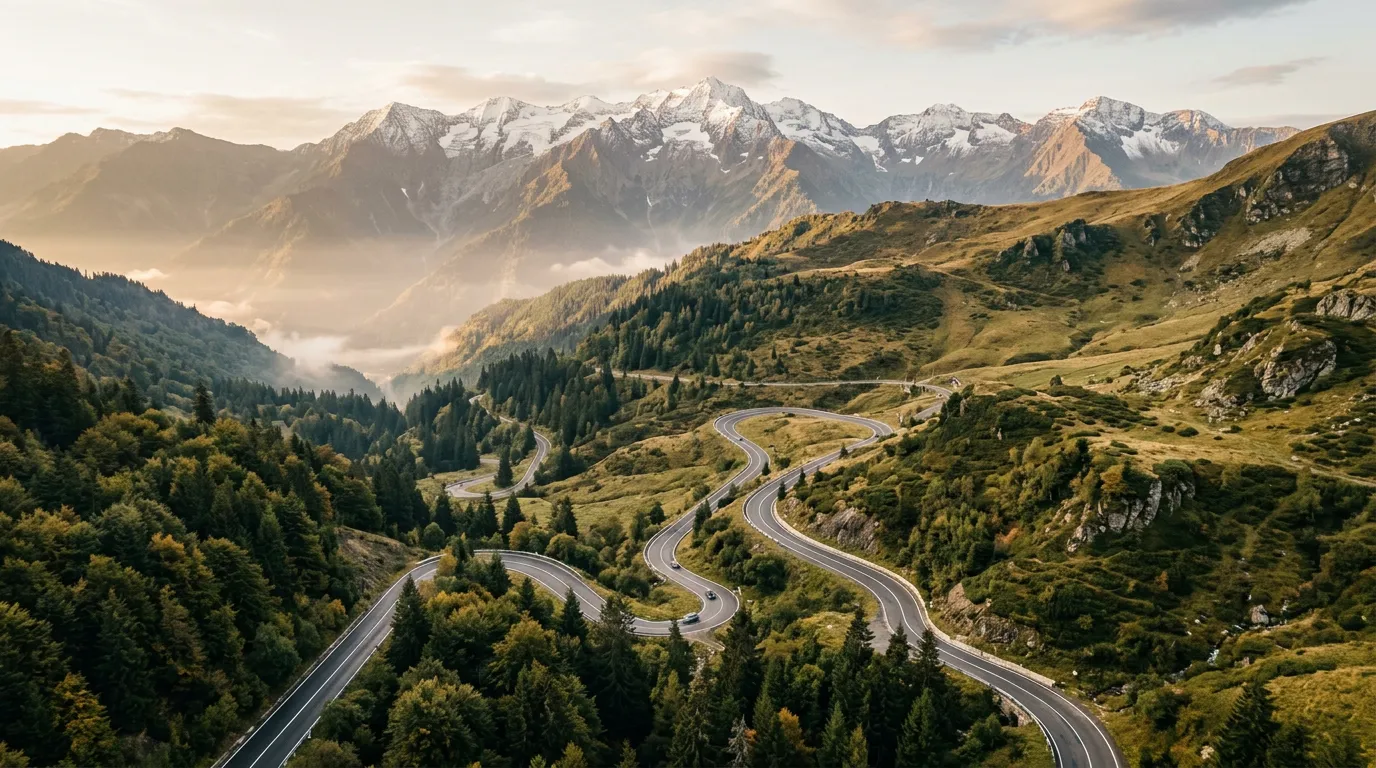
Romania has three mountain passes that matter. This statement will offend Romanians who can name a dozen others, and they would be right – the Carpathians are full of passes, from the touristic to the obscure, from paved highways to dirt tracks that require a Dacia Duster and a willingness to get lost. But for the visiting driver who has four days, a rental car, and the desire to understand what makes Romanian mountain driving unlike anything else in Europe, these are the three: the Transfagarasan, the Transalpina, and the Balan Pass.
Each is different. The Transfagarasan is the spectacle – Ceausescu’s military highway, 2,042 meters, tight stacked hairpins, Balea Lake, the road that Jeremy Clarkson called the best in the world. The Transalpina is the immersion – Romania’s highest road at 2,145 meters, 30 km of ridgeline driving above the clouds, shepherds and horses at altitude, half the traffic and twice the solitude. The Balan Pass is the meditation – 1,200 meters, Eastern Carpathian forest, almost no traffic, the kind of road where you stop making comparisons and simply drive.
This circuit links all three in a loop from Sibiu, covering approximately 450 km in four days. The sequencing is deliberate: spectacle first, immersion second, meditation third. The intensity decreases as the trip progresses, and by the final day you are driving through quiet forest with the accumulated experience of two major passes behind you, which lends the gentle Balan road a resonance it would not have on its own. The whole is greater than the sum.
Route overview
| Detail | Info |
|---|---|
| Start / End | Sibiu |
| Total distance | ~450 km |
| Driving days | 4 |
| Mountain passes | Transfagarasan (2,042m), Transalpina (2,145m), Balan Pass (~1,200m) |
| Difficulty | 3/5 (Confident driver) |
| Season | Late June to mid-October (Transfagarasan and Transalpina seasonal) |
| Fuel stops | Sibiu, Cartisoara, Curtea de Arges, Novaci, Sebes, Balan, Gheorgheni, Sighisoara |
The loop runs: Sibiu south to the Transfagarasan (north to south direction), then west across to the Transalpina (north to south), then northeast to the Balan Pass (east to west), then back to Sibiu. This routing keeps the driving directions optimal for each pass (see individual guides for direction arguments) and avoids backtracking.
Day by day
Day 1: Sibiu to Curtea de Arges via Transfagarasan (180 km, 6-7 hours)
Leave Sibiu early. The drive south to the northern entrance of the Transfagarasan (near Cartisoara) is about 40 km and takes 45 minutes. Fill your tank in Sibiu or Cartisoara – there is no fuel on the Transfagarasan.
The Transfagarasan north to south is the opening act, and it earns that position. The northern approach through the Olt Valley is pleasant but unremarkable. The forest climb is engaging. And then the tree line drops away and the hairpins begin, and for the next 20 km you are driving one of the most celebrated mountain roads on earth.
The full Transfagarasan drive is covered in our dedicated guide, but the essential points for the circuit are:
Morning timing. Start the Transfagarasan by 08:00 at the latest. By 10:00, the road from Cartisoara to Balea Lake can have significant traffic, particularly on weekends. Arriving at the hairpin section before the crowds means you can stop at the viewpoints, take photographs, and drive at your own pace without pressure.
Balea Lake. The summit tunnel delivers you to the glacial lake at 2,034 meters. Stop, but do not linger. The parking area fills quickly, and the best of the road is behind you (if you are going north to south, the hairpins are on the northern face).
Southern descent. The road south from Balea Lake is less dramatic but still excellent – sweeping curves through alpine meadow, then forest, then the Vidraru Dam and Reservoir (turquoise water, 166-meter dam, worth a photo stop).
Optional detour: Poienari Fortress. The real Dracula’s castle is accessible from the southern approach. The climb is 1,480 steps. Allow 90 minutes round trip. It is historically authentic and atmospheric in ways that Bran Castle (the tourist Dracula castle) is not. We recommend it if your legs are willing.
Continue to Curtea de Arges, a small city in the Arges Valley with decent hotels and restaurants. The Curtea de Arges Monastery is a 16th-century masterpiece of Brancoveanu architecture – ornate, almost impossibly detailed, and worth 30 minutes even if you have limited interest in ecclesiastical architecture.
Overnight: Curtea de Arges. Several hotels in the center; the Hotel Posada is reliable. Eat at a local restaurant – mici (grilled minced meat rolls), sarmale (stuffed cabbage rolls), and a cold Ursus beer after a day on the Transfagarasan. You have earned it.
Day 2: Curtea de Arges to Novaci/Ranca via Transalpina (200 km, 7-8 hours including transfer)
The transfer from Curtea de Arges to the northern entrance of the Transalpina is the longest non-pass drive of the circuit – approximately 120 km via Pitesti and the E81 to Sebes. This takes 2-3 hours and is highway driving through the Wallachian plain, not scenic but efficient. There is no direct mountain road connecting the southern end of the Transfagarasan to the northern end of the Transalpina, which is why the circuit requires this transfer.
Alternatively, you can drive north from Curtea de Arges to Sibiu (100 km) and then west to Sebes (60 km), which is slightly longer but passes through nicer scenery and returns you briefly to familiar territory.
Either way, you want to reach the northern entrance of the Transalpina (near Sebes) by early afternoon, giving you 4-5 hours of daylight for the pass.
The Transalpina (detailed guide: /romania/transalpina). If the Transfagarasan was yesterday’s spectacle, the Transalpina is today’s immersion. The northern approach climbs through forest to the Oasa Reservoir, then breaks onto the high alpine plateau – 30 km of ridgeline driving at 1,800-2,100 meters, where the road runs through the sky and the landscape looks like something from Central Asia rather than central Europe.
The rhythm of the Transalpina is different from the Transfagarasan. Where yesterday’s road was concentrated and intense, today’s is expansive and meditative. The curves are wider, the gradient gentler (on the plateau), and the sense of space is enormous. After the tight hairpins of the Transfagarasan, the Transalpina’s open ridgeline feels like a release.
The Urdele Pass summit (2,145 meters – 103 meters higher than the Transfagarasan, a fact we mention every time because it matters) is the highest point of the entire circuit. Stop. Absorb. Then descend the southern face toward Novaci, where the road tightens into flowing switchbacks through the Parang Mountains.
Overnight: Novaci or Ranca. Novaci is a small town at the southern foot of the Transalpina with basic accommodation. Ranca, a ski resort on the Transalpina at about 1,600 meters, has several guesthouses and better mountain atmosphere. If staying in Ranca, you will be on the pass itself, which is useful if you want to drive the ridgeline section again in morning light (we did this on our second trip and it was worth the early alarm).
Day 3: Novaci to Balan via transfer and Balan Pass (180 km, 5-6 hours)
Another transfer day, but a shorter one. From Novaci, drive north to Sebes (approximately 100 km via Targu Jiu and the E81), then east to the Balan Pass.
The route from Sebes to the Balan Pass runs through the Transylvanian heartland – rolling hills, fortified Saxon churches, medieval towns that UNESCO has recognized for good reason. If you have time, detour through Sighisoara (the best-preserved medieval citadel in Transylvania, birthplace of Vlad Tepes, and a UNESCO World Heritage Site) or Biertan (Saxon fortified church, also UNESCO-listed). These detours add time but immerse you in a side of Romania that the mountain passes cannot show you.
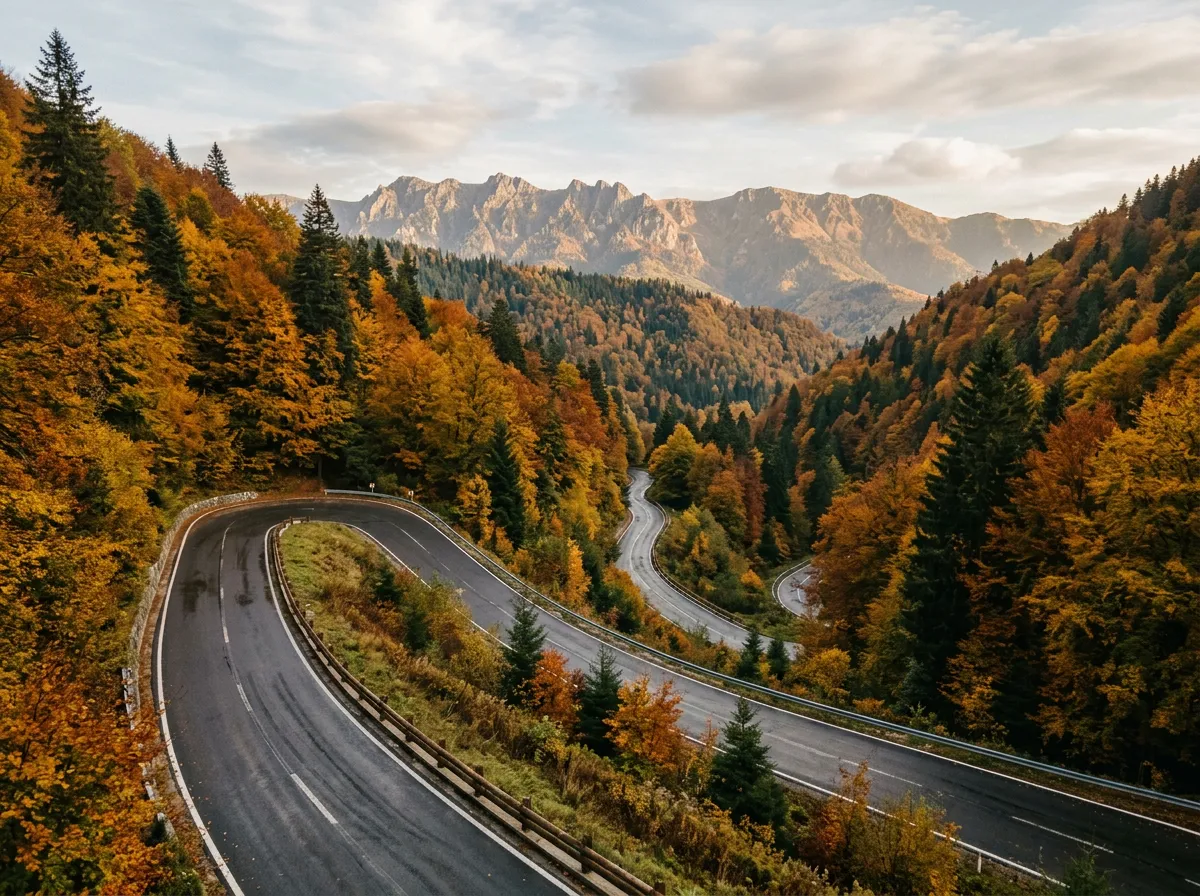
The Balan Pass itself begins in the late afternoon – perfect timing, because the eastern approach through beech and spruce forest is at its best in the slanting light of late day. The Balan Pass is the circuit’s quiet closing movement. After the Transfagarasan’s drama and the Transalpina’s grandeur, the Balan Pass offers something different: a road that asks nothing of you except attention. The 45 km of forested mountain road, the gentle summit, the possible glimpse of wildlife at dusk – it is a palate cleanser and a conclusion.
Overnight: Balan or Gheorgheni. Balan is a former mining town with limited but adequate accommodation. Gheorgheni, 30 km north, is a larger town with more options, including the excellent Hotel Teleki. Gheorgheni also serves as a base for the Bicaz Gorges, which is a worthwhile side trip if your schedule allows an extra day.
Day 4: Balan/Gheorgheni to Sibiu (200 km, 3-4 hours)
The return to Sibiu is the circuit’s bookend. The drive from Gheorgheni to Sibiu runs through the eastern Transylvanian Plateau – a landscape of wide valleys, gentle hills, and fortified villages that has changed less in the past century than almost anywhere else in Europe.
The route via Odorheiu Secuiesc and Sighisoara (E13/E60) passes through the heart of Szeklerland, the Szekler Hungarian community’s traditional territory. The carved wooden gates of Szekler villages are distinctive – elaborate, painted, and specific to this culture. If you did not detour through Sighisoara yesterday, stop today. The medieval citadel is genuinely remarkable, and the view from the Clock Tower gives you a panorama of the town and the surrounding hills.
Arrive in Sibiu by early afternoon. Sibiu itself is one of Romania’s finest cities – a former Saxon capital with a perfectly preserved old town, excellent museums (the Brukenthal is Romania’s oldest museum), and a cafe culture in the Piata Mare (Grand Square) that rewards lingering. Walk the old town. Eat at one of the restaurants around the small square (Piata Mica). Reflect on the fact that you have driven 450 km, crossed three mountain passes, gained and lost over 4,000 meters of cumulative altitude, and seen Romania from the sky-level plateaus to the forest floor.
Which car to rent
The Carpathian Pass Circuit is a difficulty-3 route, and any modern car in reasonable condition will handle it. That said, some choices are better than others:
Ideal: A compact car with a manual gearbox. Something like a Dacia Duster (Romania’s national car, basically – they are everywhere and spare parts are in every village), a Volkswagen Golf, or a Skoda Octavia. Manual gives you engine braking on the Transfagarasan’s hairpins and the Transalpina’s southern descent. Compact makes the tighter turns easier.
Acceptable: An automatic compact or small SUV. The passes are all paved and do not require AWD. An automatic will handle the gradients fine with engine braking mode (many modern automatics have this) but will feel less connected on the hairpins.
Avoid: Anything with a wheelbase longer than 4.7 meters (tight hairpins on Transfagarasan), anything without air conditioning (summer temperatures in the valleys reach 35+), anything without working brakes (this should go without saying, but we have rented cars in Romania with brake pads that could charitably be described as theoretical).
Rent from Sibiu, Bucharest, or Cluj-Napoca. Sibiu is the circuit starting point and has several agencies. Bucharest has the most options and best prices but requires a 280 km transfer drive. Cluj is 280 km north and useful only if you are coming from that direction.
Practical information
| Detail | Info |
|---|---|
| Total cost estimate | Fuel ~600 RON (~$130), accommodation ~1,200-2,000 RON (~$260-430, 3 nights), food ~400-600 RON (~$90-130) |
| Toll roads | Vignette required for national roads (DN): ~28 RON for 7 days, buy at fuel stations or online (roviniete.ro) |
| Speed limits | 50 km/h in towns, 90 km/h outside, 130 km/h on motorways, 40 km/h on mountain pass hairpin sections |
| Best months | Late June (passes just opened, wildflowers), September-early October (autumn colors, light traffic) |
| Worst time | Weekends in July-August (Transfagarasan especially crowded) |
| Road status | Check CNAIR or Infotrafic Romania app for pass openings and closures |
| Emergency | 112 (all emergencies). Mountain rescue: Salvamont (0-SALVAMONT / 0725-826668) |
| Cash | Carry some RON cash for small guesthouses and village restaurants. Cards accepted in towns. |
Romania-specific driving notes
Livestock. Sheep, cattle, and horses are on the road throughout the Carpathians, particularly on the Transalpina and Balan Pass. They have right of way. Slow down. Wait. The shepherd will eventually notice you and move them.
Logging trucks. The Balan Pass and the Transalpina’s lower sections carry occasional logging trucks. They are slow, heavy, and wide. Do not pass on blind curves. Wait for a straight section.
Police. Speed enforcement on the Transfagarasan is real, particularly on the approach roads. The radar detectors common in Western Europe are legal in Romania, but the police also use unmarked cars. Respect the 40 km/h limit on hairpin sections – it exists for good reason.
Bears. Brown bears are present in the forests of all three passes. Do not leave food in your car overnight, especially at altitude. If you encounter a bear on the road, stay in your car, do not approach, do not feed.
Individual pass guides
Each pass on this circuit has a detailed standalone guide:
- Transfagarasan – 2,042m, the famous one, Ceausescu’s military highway
- Transalpina – 2,145m, the quiet one, the King’s Road
- Balan Pass – ~1,200m, the forest one, the Eastern Carpathian crossing
For all Romanian mountain roads, see the Romania hub.