Timmelsjoch
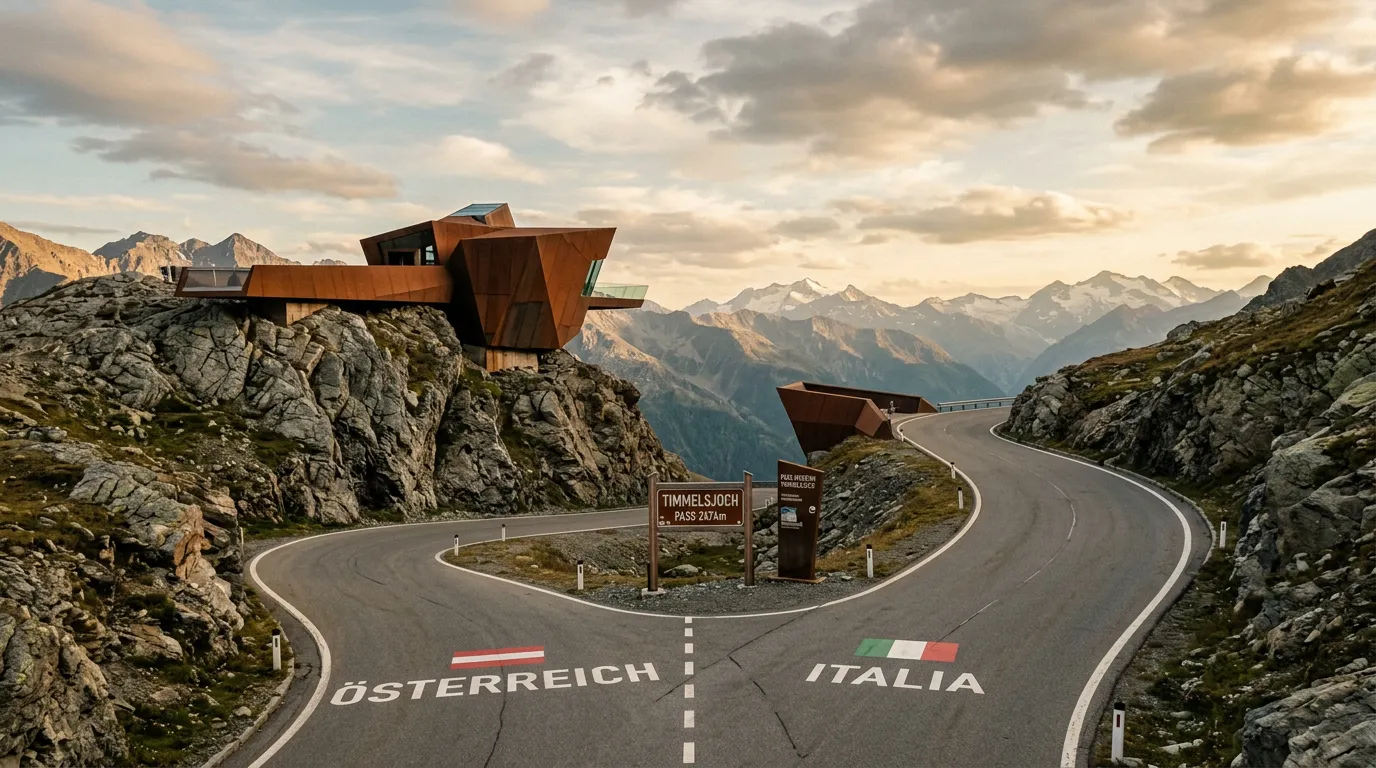
You are driving through the Otztal, Austria’s longest side valley, and at some point the road runs out of valley. The mountains close in, the gradient kicks up, and the road begins climbing toward a gap in the ridge that, from below, looks implausibly high and implausibly narrow. Through that gap — at 2,474 meters, higher than anything you can drive to in Switzerland except the Nufenen — is Italy. Not a gradual cultural transition through neutral territory, not a wide valley border crossing with a duty-free shop, but a genuine ridge-top border where you pass through a piece of modern architectural sculpture and emerge into Italian-speaking South Tyrol with its vineyards, its apple orchards, and its fundamentally different relationship with espresso.
The Timmelsjoch (called Passo del Rombo in Italian, “Thunder Pass,” which is better) is the only road connection between the Austrian Otztal and the Italian Passeier Valley. It was opened in 1959, which makes it young by alpine pass standards, and it was renovated in 2010 with a series of striking architectural installations at the summit that look like a modern art gallery wandered up a mountain and decided to stay.
Why drive the Timmelsjoch
The Timmelsjoch offers something no single-country pass can: a genuine border crossing at altitude. You drive through Austria, cross a ridge at nearly 2,500 meters, and arrive in Italy. The landscape changes, the language changes, the road quality changes (more on this later), and the coffee improves dramatically. This cross-border quality gives the Timmelsjoch a narrative dimension that domestic passes lack — you are not just driving up and down a mountain, you are crossing between two countries, two cultures, and two fundamentally different approaches to alpine road maintenance.
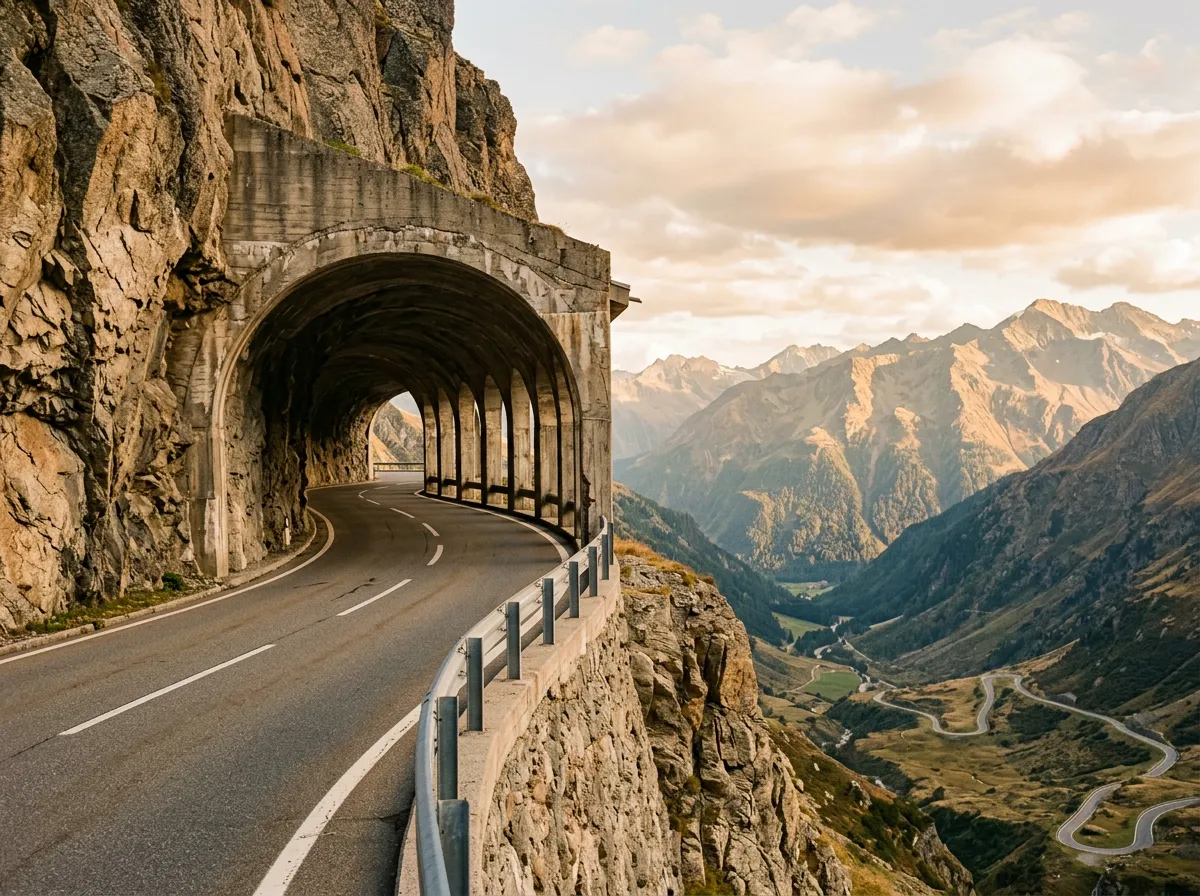
The Austrian side is precisely what you would expect from Austria: engineered, maintained, organized. Wide asphalt, modern guardrails, numbered hairpins. The Italian side is precisely what you would expect from Italy: dramatic, slightly wild, and occasionally featuring single-lane gallery sections blasted through cliff faces where the oncoming traffic has the right of way in theory but not always in practice.
Both sides are spectacular, and the contrast between them is half the experience. The Timmelsjoch teaches you that the same Alps produce very different driving experiences depending on which side of the border built the road.
The summit area, with its architectural installations by the Austrian firm Werner Tscholl, is genuinely remarkable. Five sculptural structures — a bridge, a telescope-like viewing platform, a walk-through passageway, and two gallery buildings — sit at the pass summit as interpretive stations explaining the geology, history, and ecology of the border zone. They are made of weathering steel (corten), which gives them a rust-orange color that stands out dramatically against the gray rock. Whether you consider this architecture or art is a personal judgment. We consider it both.
Which direction to drive
North to south. Start in Solden (1,377m, Otztal) and finish in St. Leonhard in Passeier (689m, South Tyrol).
The Austrian ascent from Solden is longer and more gradual, giving you time to warm up and appreciate the engineering. The Italian descent is steeper, tighter, and more adventurous — better to descend this side, where gravity helps you through the narrow gallery sections, than to climb it, where meeting a tour bus head-on in a single-lane tunnel requires one of you to reverse uphill.
There is also a culinary argument. Finishing in Italy means finishing with Italian food. St. Leonhard has trattorias. Merano, 30 minutes further south, has Michelin-starred restaurants and an urban promenade lined with palm trees. If you must earn your dinner, earning it by descending a high alpine pass into a town with excellent wine and pasta is the civilized way to do it.
Kilometer by kilometer
Km 0-6: Solden to the Otztal upper valley
From Solden — one of Austria’s most famous ski resorts, busy in winter and surprisingly quiet in summer — the road follows the Otztaler Ache upstream through a valley that narrows progressively. The first six kilometers are valley driving: flat-ish, two lanes, with the mountains squeezing in from both sides. The Otztal’s upper reaches are wilder than the manicured lower valley, with boulders in the riverbed and conifer forest pressing against the road.
Km 6-12: The toll gate and Austrian hairpins
The toll gate appears at roughly 1,800m. The toll for the full road (Austria to Italy or vice versa) is approximately EUR 17 per car (2025). Motorcycles pay EUR 12. Keep the receipt.
Above the toll gate, the road gets serious. The hairpins begin — well-spaced at first, then tightening as the gradient increases to 10-12%. The asphalt is excellent, and each turn has been engineered with the kind of precision that makes you think the road builders had a protractor and strong opinions about apex geometry.
The landscape above the tree line is granite and sparse grass, with marmots whistling from the rockfields as you pass. (Marmots whistle to warn each other about predators. It is unclear whether they classify rental cars as predators, but they whistle at them regardless.) The views back down the Otztal extend to the valley’s distant mouth, and on clear days you can trace the road you have driven as a thin line through the green.
Km 12-16: The summit and the architecture
The summit zone at 2,474m is where the Timmelsjoch distinguishes itself from every other alpine pass. The five architectural installations designed by Werner Tscholl are positioned at intervals along the final two kilometers of the Austrian side and the first kilometer of the Italian side. They are impossible to miss — angular corten steel structures that emerge from the mountainside like geological formations that happen to have doors and windows.
The largest installation, a walk-through structure at the summit itself, frames the border crossing. You enter on the Austrian side and exit on the Italian side, passing through a corridor that contains historical photographs and geological displays. It is simultaneously a border post, a museum, and a piece of land art. The fact that it exists at all — that someone proposed building contemporary architecture at 2,474 meters and someone else said yes — tells you something about the ambition of this road.
The summit parking area is small but adequate. Stop here. Walk through the installations. Look at the view. You are standing at the watershed between the Inn drainage (north, to the Danube and Black Sea) and the Adige drainage (south, to the Adriatic). The geological history is written in the rock around you, and the architectural installations make a genuine effort to help you read it.
Km 16-22: The Italian galleries
Cross the border, and the road changes character immediately. The Italian side of the Timmelsjoch was built through more difficult terrain, and the solution was gallery sections — semi-tunnels blasted from the cliff face with open sides. These galleries are narrow (single-lane in places), unlit, and occasionally feature views through the open side that reveal exactly how much air is between you and the valley floor.
The sensation is of driving through a series of stone doorways along the edge of a cliff. Traffic lights at each end of the single-lane galleries control the flow, but the timing is generous and you rarely wait long. When it is your turn, drive through smoothly and without stopping — these are not places to pause for photographs, no matter how dramatic the view through the gallery opening.
Below the galleries, the road widens to two lanes and descends through tight hairpins into the Passeier Valley. The vegetation appears rapidly — first grass, then shrubs, then pine forest, then, as you drop below 1,500 meters, the first apple orchards and vineyards that signal South Tyrol’s Mediterranean microclimate.
Km 22-28: St. Leonhard and the Passeier Valley
St. Leonhard in Passeier (689m) is a quiet South Tyrolean town that sits at the foot of the Timmelsjoch and makes an excellent end point. The town has a museum dedicated to Andreas Hofer — the Tyrolean folk hero who led a rebellion against Napoleon in 1809 and was born here — which is interesting but perhaps not as immediately relevant as the fact that the town also has excellent Italian restaurants and South Tyrolean wine.
From St. Leonhard, Merano is 30 minutes south. Merano is a spa town with promenades, gardens, and an urban energy that feels improbable after the granite and marmots of the Timmelsjoch summit. The contrast is the point: you start your morning in an Austrian ski resort and end your afternoon in an Italian spa town, and between them you have crossed a 2,474-meter ridge through a piece of architectural sculpture. Few drives offer that kind of range.
Practical information
| Detail | Information |
|---|---|
| Opening dates | Typically early June to late October (weather-dependent) |
| Toll | EUR 17.00 per car (2025), either direction. Motorcycles EUR 12.00. |
| Gate hours | Jun-Sep: 7:00-20:00. May/Oct: 8:00-17:00. Last entry 1 hour before closing. |
| Fuel | Solden (north), St. Leonhard (south). None on the pass. |
| Parking | Small lot at summit. Pull-offs along Austrian side. Limited on Italian galleries. |
| Best time of day | Morning for clear conditions; afternoon light is dramatic on the architectural installations |
| Avoid | Tour bus convoys on the Italian galleries (they block the single-lane sections). Check the webcam. |
| Length | 28 km Solden to St. Leonhard |
| Drive time | 50-70 minutes without stops |
| Facilities | Restaurant at summit (seasonal). Otherwise, nothing between toll gates. |
| Italian galleries | Single-lane, traffic-light controlled. Be patient. |
Combine with nearby passes
Timmelsjoch + Jaufenpass: From St. Leonhard, continue south and then east to the Jaufenpass (2,094m), a free road connecting the Passeier Valley to the Wipp Valley near the Brenner motorway. The Jaufenpass is a good intermediate-level pass with tight hairpins and views of the Stubai Alps. The two together make a full day of cross-border driving.
Timmelsjoch + Stelvio: If you continue from St. Leonhard to Merano and then west, you can reach the Stelvio Pass (2,757m) in about 90 minutes. The Stelvio is the great Italian mountain road — 48 hairpins on the Bormio side — and chaining it with the Timmelsjoch creates a two-day, two-country, two-legend route. But the Stelvio deserves its own trip.
The Trilogy: The Timmelsjoch can substitute for the Gerlos in the Tyrol Pass Trilogy if you want a higher-altitude, more challenging middle day. The routing is less convenient (you need to cross into Italy and return), but the driving is more memorable.
The Timmelsjoch is what happens when two countries share a mountain and approach it differently. Austria builds the road with precision. Italy builds the road with drama. And then someone installs contemporary art at the point where they meet, which is either the most European thing imaginable or the most Austrian, depending on your perspective. We love this pass for the same reason we love borders: because the transition matters. The moment you cross from Austrian asphalt to Italian gallery section, from marmot territory to apple orchard, from Schnitzel country to pasta country — that moment is worth the toll.