The Tyrol Pass Trilogy
The Austrian Alps do not have Switzerland’s pass density — you cannot chain five passes in three days from a single town the way the Alpine Pass Pentathlon does from Andermatt. What Austria has instead is range. The three passes in this trilogy — Grossglockner, Gerlos, and Silvretta — are spread across 300 kilometers of the Austrian Alps, each one in a different mountain group, each one with a distinct character, and each one connected by valley roads that are themselves worth driving.
The Trilogy is not a concentrated assault. It is a traversal. Over three days, you cross the Austrian Alps from east to west, from the Hohe Tauern’s glaciated peaks to the Silvretta’s reservoir lakes, with the Zillertal’s waterfalls in between. The driving is less intense than Switzerland’s pass country — the gradients are gentler, the hairpins wider, the toll-road surfaces impeccable — but the cumulative experience is substantial. By the end of day three, you will have covered 320 kilometers, crossed three mountain ranges, and developed a strong opinion about Austrian road maintenance (the opinion will be positive).
We designed this route with a base in Zell am See, but Innsbruck works equally well. Both are proper Austrian alpine towns with good car rental options, comfortable hotels, and the infrastructure that a driving trip requires.
Route overview
Day 1: Zell am See — Grossglockner High Alpine Road (S to N or N to S loop) — Zell am See. One toll pass, approximately 100km round trip, overnight in Zell am See.
Day 2: Zell am See — Gerlos Pass (E to W) — Inntal — Landeck or Innsbruck. One free pass, approximately 130km, overnight in Landeck or Innsbruck.
Day 3: Landeck — Silvretta High Alpine Road (W to E or E to W) — Galtür/Partenen — return to Innsbruck or Zell am See. One toll pass, approximately 90km, end of route.
Total: approximately 320 kilometers including connecting roads.
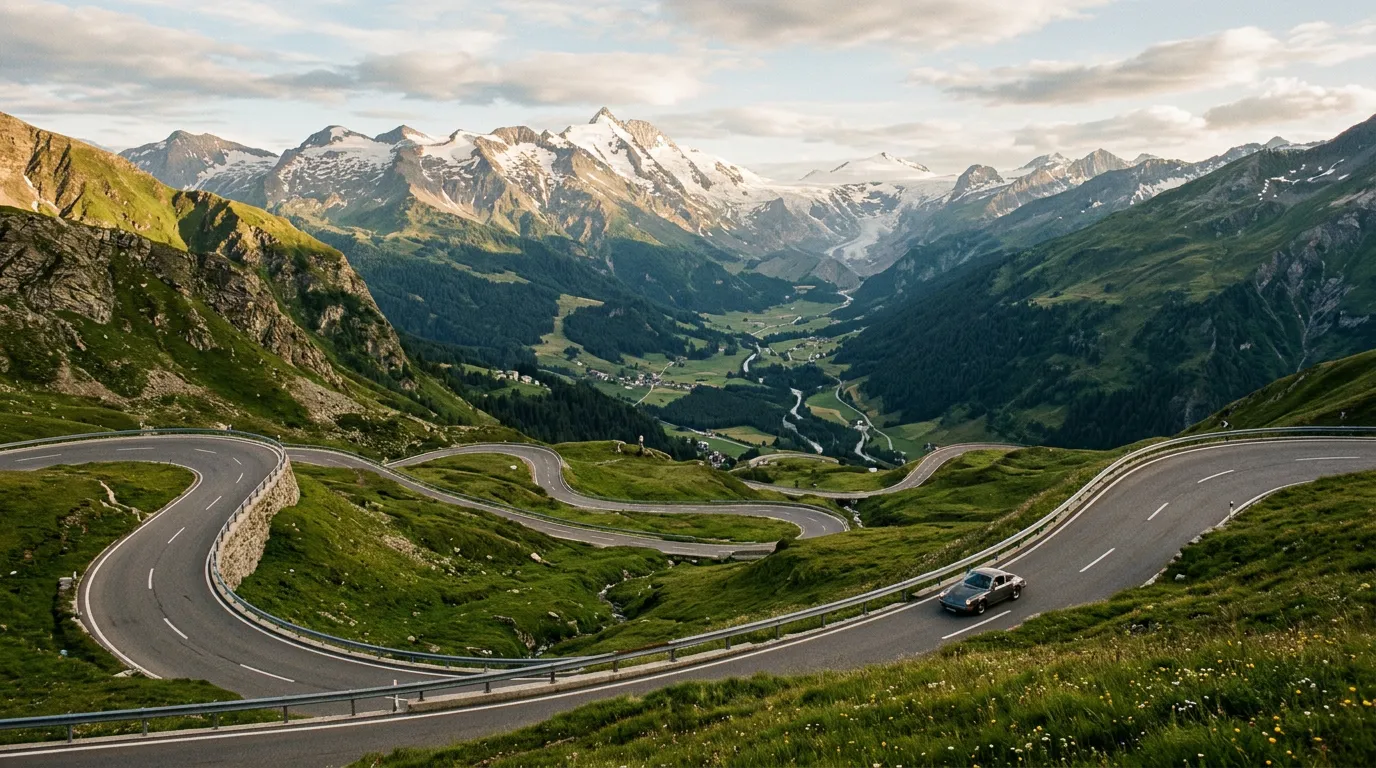
Day 1: Grossglockner High Alpine Road
Zell am See to Grossglockner and back
The Grossglockner is the obvious opening act. It is Austria’s most famous drive, and for good reason: 48 kilometers of road, 36 hairpins, a 2,504-meter summit, and two spur roads (Franz-Josefs-Hohe and Edelweisspitze) that deliver the two best viewpoints in the Austrian Alps.
From Zell am See, drive south through Bruck an der Glocknerstrasse to the northern toll gate (approximately 30 minutes from Zell am See). The toll is EUR 41.50 per car (2025), which includes access to both spur roads and same-day re-entry.
We recommend driving north to south: climb from Bruck through the Fuscher Valley, stop at Edelweisspitze (2,571m) for the panorama, continue over the Hochtor tunnel, take the Franz-Josefs-Hohe spur road for the glacier viewpoint and lunch, then descend to Heiligenblut on the southern side.
From Heiligenblut, you have two options for returning to Zell am See:
- Return over the Grossglockner (same-day re-entry, no additional toll). This gives you the pass twice — once in each direction. If the morning was cloudy and the afternoon is clearing, this is the better choice.
- Return via the Molltal and Tauern motorway tunnel. Drive south from Heiligenblut to Winklern, then east to the Felbertauern tunnel (toll, approximately EUR 12), which takes you back to the Salzach Valley and Zell am See. Longer but avoids repeating the pass.
Allow 4-6 hours for the Grossglockner depending on stops. This is a full-day pass. Do not rush it.
Detailed guide: Grossglockner High Alpine Road
Overnight: Zell am See
Zell am See is a lakeside town in the Salzburg Alps with a pedestrianized center, good restaurants, and views of the Kitzsteinhorn glacier across the water. It is popular year-round (skiing in winter, hiking and water sports in summer), so book accommodation in advance during July and August.
For drivers, Zell am See has practical advantages: central location for the Grossglockner, fuel stations, and several car rental offices. The Grand Hotel is the classic choice if budget allows. Otherwise, the town has dozens of three and four-star options.
Fuel up tonight. Tomorrow’s route covers 130 kilometers with limited fuel stops on the Gerlos.
Day 2: Gerlos Pass
Zell am See to Landeck via Gerlos Pass
The Gerlos is the Trilogy’s transition pass. Where the Grossglockner is the spectacle and the Silvretta is the connoisseur’s choice, the Gerlos is the connector — a 1,507-meter crossing between the Salzach Valley and the Zillertal that is pleasant, scenic, and entirely free of toll.
From Zell am See, drive west along the Salzach Valley to Mittersill (30 minutes). From Mittersill, the Gerlos road (B165) climbs south through the village of Krimml and past the Krimml Waterfalls — at 380 meters total drop, the highest waterfalls in Austria and the fifth-highest in Europe. The waterfalls are a 20-minute walk from the road and worth the detour, even on a driving trip. We generally resist the impulse to leave the car, but the Krimml Waterfalls break our resistance.
Above Krimml, the road climbs to the Gerlos Pass (1,507m) through gentle hairpins in forested terrain. The summit is unremarkable — a parking area, a restaurant, a pass sign — but the road itself is smooth and the curves are flowing. This is the kind of drive where you settle into a rhythm and cover ground comfortably.
The western descent into the Zillertal is the better half of the Gerlos. The road drops through a series of gallery sections and tunnels with views of the Zillertal Valley below — a broad, prosperous valley with ski resorts (Mayrhofen, Zell am Ziller) visible in the distance. The descent is gentle enough that brake management is not a concern.
From the bottom of the Gerlos, drive north through the Zillertal to the Inn Valley, then west along the A12 motorway to Landeck or Innsbruck. This is valley and motorway driving — efficient but not exciting. The excitement is behind you (Grossglockner) and ahead of you (Silvretta).
Overnight: Landeck or Innsbruck
Landeck is the closer option to tomorrow’s Silvretta start. It is a small Tyrolean town at the junction of the Inn Valley and the Arlberg route, with adequate hotels and restaurants and a position that makes it practical for pass driving.
Innsbruck is an hour further east but offers dramatically more to do: the Old Town, the Hofburg palace, Maria-Theresien-Strasse, and the full range of a provincial capital’s restaurants and nightlife. If you want a proper city evening between pass days, Innsbruck is the choice. Just be aware that it adds an hour to tomorrow’s drive.
Day 3: Silvretta High Alpine Road
Landeck to Silvretta and return
The Silvretta is the Trilogy’s quiet finale. Where the Grossglockner shouts and the Gerlos hums, the Silvretta speaks at a conversational volume about reservoir lakes, granite, and the particular quality of light at 2,000 meters in the Vorarlberg Alps.
From Landeck (or Innsbruck), drive west through the lower Inn Valley to the Montafon junction, then south through the Montafon Valley to Partenen and the Silvretta toll gate. The toll is EUR 16.50 per car (2025).
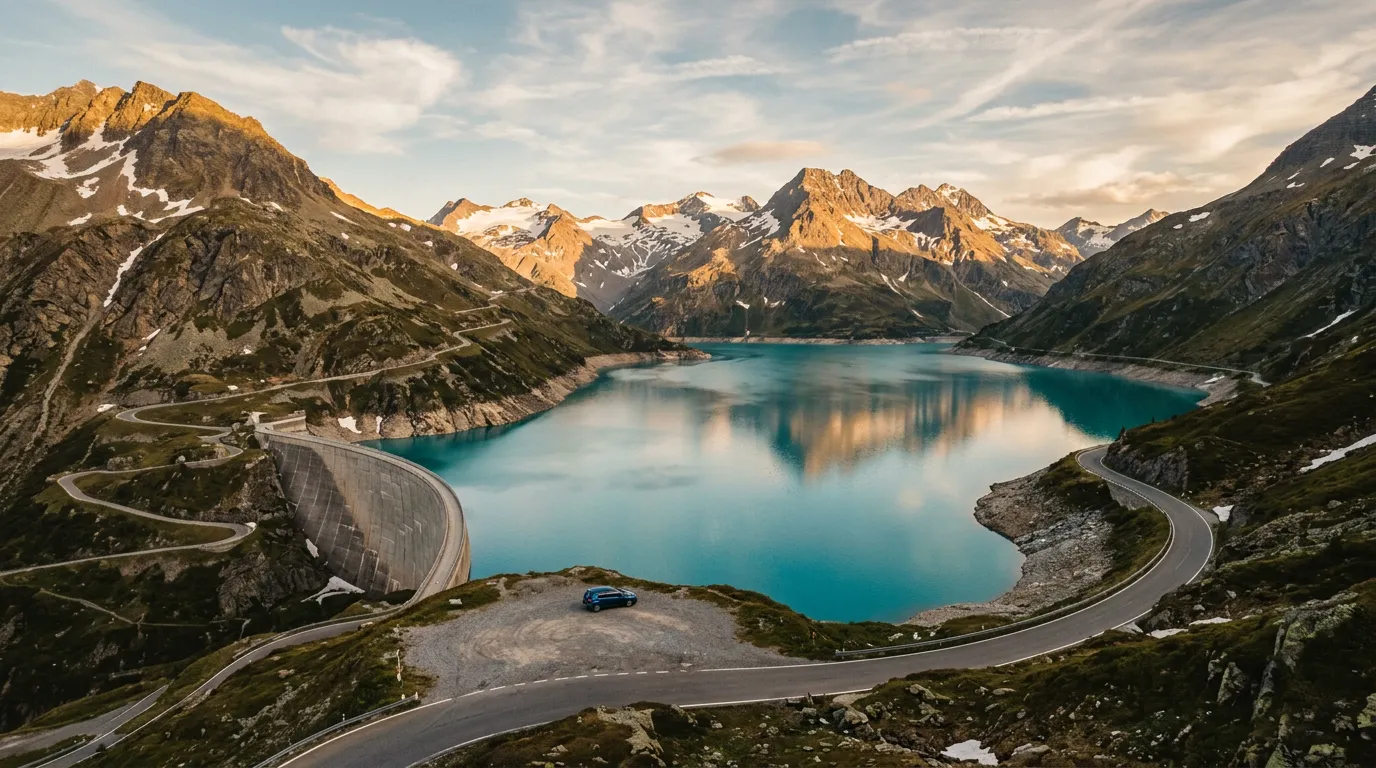
We recommend driving east to west: climb from Partenen through the 32 hairpins to the Bielerhöhe summit (2,032m), have lunch at the Silvrettahaus, walk across the dam, then descend to Galtür. The eastern ascent concentrates the hairpins into the first twelve kilometers — climbing them is easier on brakes and nerves than descending them.
The Bielerhöhe reservoir is the Silvretta’s centerpiece. The lake sits in a high valley surrounded by the Silvretta and Vermunt mountain groups, with the Piz Buin (Vorarlberg’s highest peak) visible to the south on clear days. The water color, the granite shores, and the general absence of other people create an atmosphere that is more Norway than Austria. We have sat on the dam wall here for thirty minutes at a time, watching the light change on the water. This is not a pass you rush.
From Galtür, return east through the Paznaun Valley to Landeck and then to your final destination. If continuing to Innsbruck, add an hour. If returning to Zell am See, take the A12 east through the Inn Valley and the Tauern motorway south — approximately 2.5 hours.
Detailed guide: Silvretta High Alpine Road
Which car to rent
The Trilogy is even more forgiving on cars than the Swiss Pentathlon. All three roads are well-surfaced, the gradients are moderate, and the Austrian attention to road maintenance means you are unlikely to encounter potholes, loose gravel, or surprise obstacles.
Any modern car with at least 120 horsepower will handle the Trilogy comfortably. AWD is unnecessary. Manual is preferred (engine braking on the Grossglockner’s northern descent and the Silvretta’s eastern hairpins) but automatic works fine with manual override.
| Category | Good choices |
|---|---|
| Economy | VW Golf, Skoda Octavia, Seat Leon |
| Mid-range | BMW 1 Series, Audi A3, Mazda 3 |
| Comfortable | Audi A4 Avant, BMW 3 Series Touring — the estates handle Austrian roads beautifully |
Rent from Innsbruck, Salzburg, or Zell am See. Innsbruck has the best selection; Zell am See has the shortest transfer to Day 1.
Practical information
| Detail | Information |
|---|---|
| Total distance | ~320km (including valley connections) |
| Total elevation gain | ~5,500m cumulative |
| Best period | Late June to mid-September (all three passes reliably open) |
| Tolls | Grossglockner: EUR 41.50. Gerlos: free. Silvretta: EUR 16.50. Total: ~EUR 58. |
| Fuel strategy | Fuel in Zell am See (Day 1), Mittersill or Krimml (Day 2), Partenen or Galtür (Day 3) |
| Budget (fuel) | ~EUR 40-50 for the full route |
| Budget (accommodation) | EUR 80-150/night for a solid double room in Zell am See or Landeck |
| Difficulty | 2/5 overall — the gentlest multi-day pass route we recommend |
Alternatives and variations
Swap Gerlos for Timmelsjoch: Replace the Gerlos (Day 2) with the Timmelsjoch for a higher, more dramatic middle day. Drive south from Innsbruck to Solden, cross the Timmelsjoch into Italy, then return via the Brenner. This adds border-crossing drama and modern architecture but requires backtracking.
Add Stelvio: If you are willing to extend to Day 4, continue from the Silvretta to the Arlberg Pass, then south through Switzerland to Bormio and the Stelvio Pass. This takes you into Italy’s most famous hairpin road and creates a cross-border trilogy-plus-one that covers three countries in four days.
Start from Salzburg: Salzburg is 1.5 hours from Zell am See and has major car rental offices at the airport. Start on Day 0 with the drive to Zell am See through the Tauern motorway tunnels, passing the exits for castles and lakes that make this stretch of Austrian motorway distractingly scenic.
Weekend version: If three days is too many, do the Grossglockner on Saturday and the Silvretta on Sunday, skipping the Gerlos. Two of the three passes, two days, and the best of the Trilogy concentrated into a long weekend.
Individual pass guides
- Grossglockner High Alpine Road — 2,504m, 36 hairpins, Austria’s most famous
- Gerlos Pass — 1,507m, free, Krimml Waterfalls, the scenic connector
- Silvretta High Alpine Road — 2,032m, 32 hairpins, the connoisseur’s pass
Comparing the Trilogy to the Swiss Pentathlon
This is the question we get most often: Swiss Pentathlon or Austrian Trilogy?
Choose the Pentathlon if: you want intensity, variety, and bragging rights. Five passes in three days, including cobblestones. The Swiss passes are more concentrated, more varied, and more demanding. The Pentathlon is a workout.
Choose the Trilogy if: you want comfort, scenery, and time to appreciate each pass. Three passes in three days, all with excellent infrastructure. The Austrian passes are more spacious, better maintained (at the cost of toll fees), and less physically tiring. The Trilogy is a holiday.
Both are excellent. The Pentathlon is the one you train for. The Trilogy is the one you recommend to your parents.
Three days, three passes, three mountain ranges. The Grossglockner for the spectacle. The Gerlos for the waterfalls and the rhythm. The Silvretta for the silence and the reservoir. Austria does not do pass driving with the obsessive density of Switzerland, but what it does, it does with a polish and a generosity that makes every kilometer feel considered. The toll booths are the tax. The driving is the reward. We have driven this route twice now, and the second time was better than the first, because we knew what was coming and could anticipate the pleasures — the Franz-Josefs-Hohe terrace, the Krimml mist on our face, the Bielerhöhe dam walk — instead of discovering them. Discovery is overrated. Anticipation is underrated. The Trilogy rewards both.