The Engadin Circuit
Not everyone wants the Pentathlon. Five passes in three days, a hundred-plus hairpins, the Gotthard’s cobblestones vibrating through your steering wheel — it is a magnificent experience, but it is also exhausting. Some drivers want the Alps without the boot camp. Some want scenery that does not require a death grip on the wheel. Some simply want to arrive at dinner without adrenaline-shaking hands and an urgent need to talk about brake temperatures.
The Engadin Circuit is for those drivers.
Three passes — Julier, Bernina, and Maloja — over two days, through the Engadin Valley in southeastern Switzerland. The total distance is 180 kilometers. The maximum difficulty is a 2. The landscape is lake-and-mountain perfection of a kind that makes you understand why the Engadin has been attracting wealthy visitors since the 1850s. And the driving, while not hairpin-intensive, is flowing, varied, and deeply satisfying in the way that a well-made road through spectacular scenery always is.
This is the pass circuit for people who want to drive well, not drive hard.
Route overview
The circuit forms a rough triangle in the southeast corner of Switzerland, with St. Moritz at its center:
Day 1: Chur — Julier Pass (N to S) — Silvaplana — St. Moritz. One pass, 80km, overnight in St. Moritz.
Day 2: St. Moritz — Bernina Pass (N to S) — Poschiavo — return via Bernina — Maloja Pass (E to W) — Chiavenna (Italy) — return via Maloja or continue. Two passes, 100km.
The circuit can be driven as a loop returning to Chur, or as a one-way if you are continuing into Italy or Austria. It also pairs well with the Austrian Tyrol Pass Trilogy — from St. Moritz, Innsbruck is three hours via the Inn Valley.
Day 1: Julier Pass
Chur to Silvaplana via Julier Pass
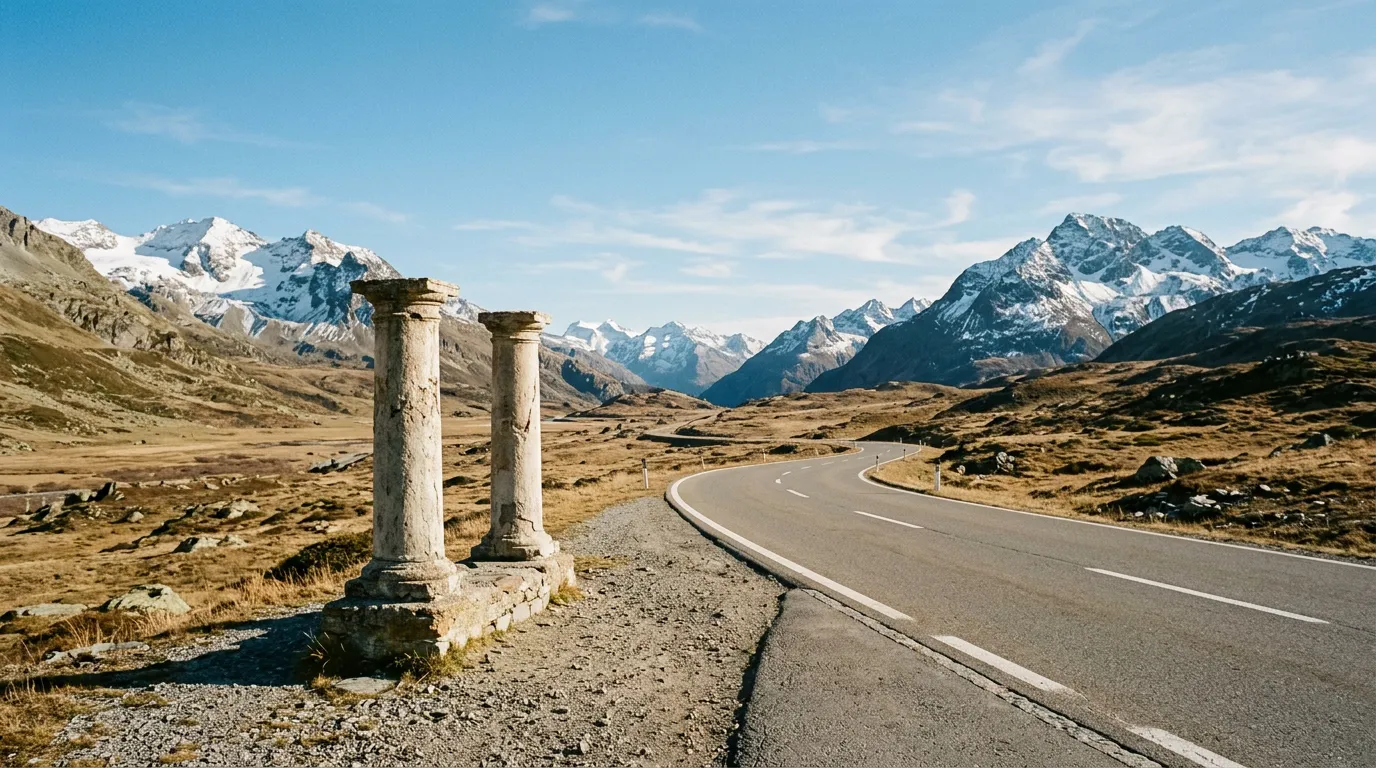
The Julier (or Giulia, in Romansh) is one of the oldest Alpine crossings. Romans used this route — you can still see the fragments of two Roman columns at the summit. Unlike most Swiss passes that close for winter, the Julier stays open year-round, kept clear by snowplows through the worst of the Swiss winter. This tells you two things: the gradient is moderate, and the road is important enough to justify continuous maintenance.
From Chur (585m), the road follows the Albula Valley south through Tiefencastel, a village at the junction of several valleys that has been a crossroads since the Bronze Age. The Julier ascent begins in earnest above Bivio (1,769m), climbing through broad, sweeping curves to the summit at 2,284m. The gradients rarely exceed 7%, and the road width is generous throughout — two comfortable lanes with room for overtaking on the straighter sections.
The summit landscape is surprisingly austere: a high plateau of rock and sparse grass, with the two Roman column stumps standing beside the road like sentinels from a civilization that valued trade routes more than scenic viewpoints. The columns have been here for nearly two thousand years. The road has been improved somewhat since then.
The descent to Silvaplana is short and scenic, dropping into the upper Engadin Valley with views of the Silvaplanersee (Lake Silvaplana) — a lake famous for its windsurfing conditions, which are relevant only if you have brought a wetsuit. The lake is turquoise, the mountains are reflected in it, and the whole scene has the precision of a Swiss tourism photograph because, in fact, many Swiss tourism photographs were taken here.
Overnight: St. Moritz or Pontresina
St. Moritz needs no introduction. It is the most famous resort town in Switzerland, possibly in Europe, and it has prices to match. If your budget allows, stay — the town is beautiful, the restaurants are excellent, and watching the sunset over the lake from the terrace of the Kulm Hotel is worth the cost of at least one night.
For more moderate budgets, Pontresina (10 minutes east) offers the same Engadin scenery at lower prices. It is also the closer starting point for the Bernina Pass on Day 2.
Both towns have ample parking, fuel, and every amenity a tired driver could want.
Day 2: Bernina and Maloja
Morning: Bernina Pass (St. Moritz to Poschiavo and back)
The Bernina is the highest pass in the Eastern Alps at 2,328m, and it is also the most railway-friendly. The Bernina Express — the UNESCO-listed red train that climbs from St. Moritz to Tirano — runs alongside the pass road for much of its length. This means you will occasionally see a bright red train threading through the same landscape you are driving through, which is either delightful or slightly annoying depending on whether you believe roads or railways are the superior form of mountain transport.
From St. Moritz (or Pontresina), the road climbs south through the Bernina Valley. The landscape transitions from larch forest to bare alpine terrain, with the Morteratsch Glacier visible to the east — one of the most accessible glaciers in the Alps, with a hiking trail from the Morteratsch railway station that reaches the glacier terminus in about an hour. Worth the stop if you have the time, though the glacier has retreated significantly from its position even twenty years ago.
The summit at 2,328m is marked by the Lago Bianco (White Lake), a reservoir whose milky turquoise color comes from glacial flour. The lake, the surrounding peaks, and the Bernina Express railway create a composition that is almost absurdly picturesque. The parking area at the summit is where you take the photograph that will become your phone wallpaper for the next six months.
The southern descent to Poschiavo drops into the Valposchiavo, an Italian-speaking valley that feels distinctly Mediterranean despite being technically in Switzerland. The road passes through covered galleries and tight switchbacks, arriving in Poschiavo (1,014m) — a town of stone houses, espresso bars, and a language change that happens without a border crossing.
We recommend driving to Poschiavo, having coffee, and then returning over the Bernina the same way. Continuing to Tirano (Italy) is possible but adds significant distance if you plan to complete the circuit today. Save Italy for another trip.
Afternoon: Maloja Pass (St. Moritz to Chiavenna or return)
The Maloja is the strangest pass on this circuit. It has a summit at 1,815m, but you would not know it from the west side because there is no western ascent. The road runs along the flat floor of the upper Engadin Valley to the Maloja summit — which is just the edge of the valley — and then drops precipitously into the Val Bregaglia on the Italian side. The result is a pass that is completely flat from one direction and a wall from the other.
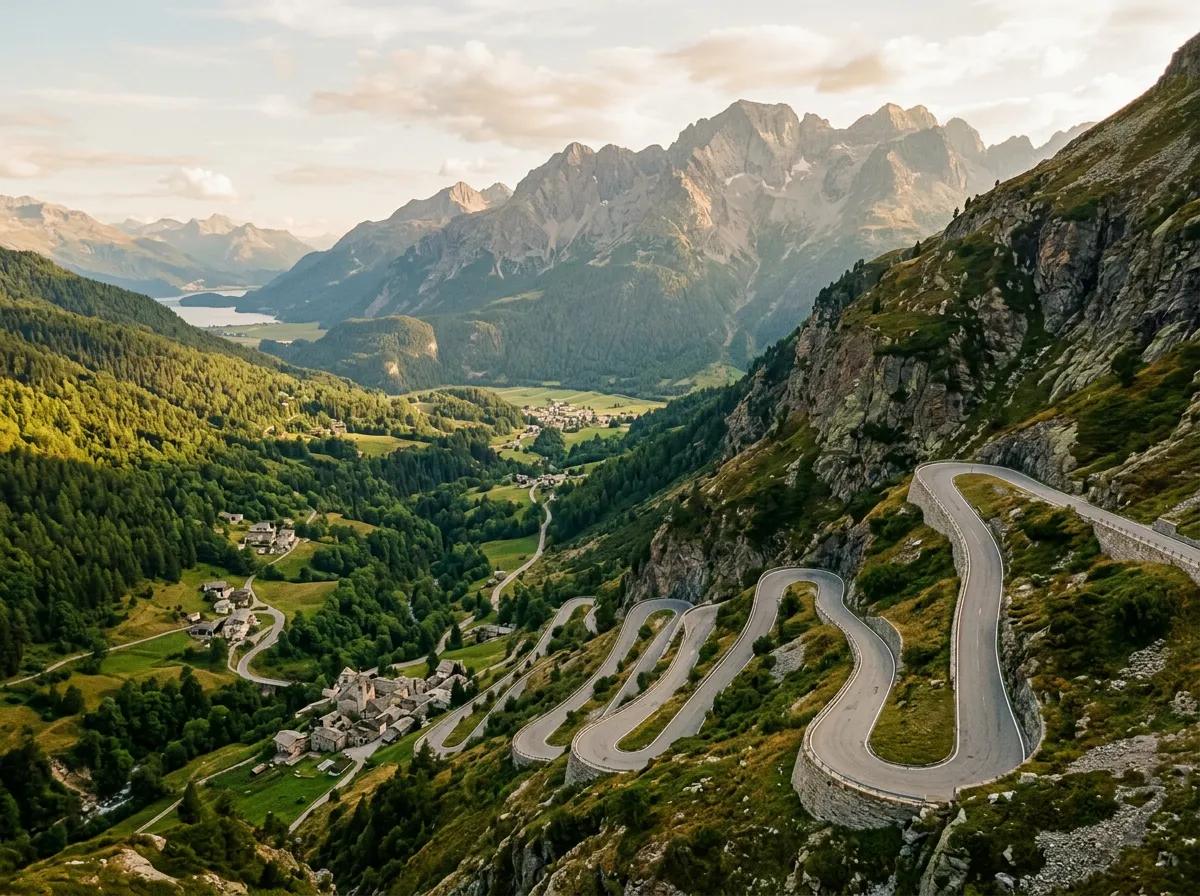
Driving east to west (from St. Moritz toward Chiavenna), you cruise along the valley floor past the Engadin lakes — Champfer, Silvaplana, Sils — and then suddenly the road drops off the edge of the valley in a series of tight hairpins that lose 300 meters in about two kilometers. It is like driving off a cliff, except with asphalt and guardrails.
The Val Bregaglia below is gorgeous: chestnut forests, stone villages, and a microclimate warm enough for walnut trees. The road continues to Chiavenna in Italy, a town that makes excellent pizza and serves as a gateway to Lake Como. If your itinerary allows, continue to Chiavenna for lunch and return via the same road. If not, the Maloja hairpins alone are worth the drive from St. Moritz — 30 minutes out, 30 minutes back, and one of the most dramatic valley drops in the Alps.
Which car to rent
The Engadin Circuit is forgiving on cars. The gradients are moderate (except the Maloja descent), the road surfaces are perfect, and the distances are short. Any modern car with at least 100 horsepower will do the job comfortably.
That said, this is St. Moritz country. If there is ever a time to rent something nicer than usual, this is it. The Engadin’s flowing roads reward a car with good handling more than raw power. A convertible on the Julier summit in September sun is an experience that justifies the rental premium.
| Category | Recommendations |
|---|---|
| Budget | Any compact with 100+ hp — VW Golf, Renault Megane, Skoda Octavia |
| Mid-range | BMW 3 Series, Audi A4, Volvo V60 |
| Treat yourself | Porsche 718, BMW Z4, Audi TT — the Engadin roads reward a good chassis |
Rent from Zurich (2.5 hours to Chur), or from Chur itself if available.
Why the Engadin Circuit instead of the Pentathlon
Choosing between these two itineraries is not a quality judgment — it is a personality test.
Choose the Pentathlon if: you want hairpins, adrenaline, variety, and a sense of accomplishment measured in passes conquered. You want the Tremola cobblestones, the Furka’s Bond heritage, and the Grimsel’s lunar weirdness. You define a good drive by how many times your heart rate elevated.
Choose the Engadin Circuit if: you want scenery, flow, and a pace that allows appreciation rather than survival. You want to stop for coffee at glacier viewpoints without worrying about your schedule. You want to arrive at dinner calm rather than wired. You define a good drive by how many times you said “look at that” rather than how many times you said a word unsuitable for print.
Both are excellent. The Pentathlon is Switzerland’s greatest hits. The Engadin Circuit is its deep cut — the one the locals recommend.
Practical information
| Detail | Information |
|---|---|
| Total distance | ~180km |
| Total elevation gain | ~3,500m cumulative |
| Best period | Late June to September for all three passes; Julier open year-round |
| Fuel strategy | Fuel in Chur, St. Moritz, Poschiavo. No fuel on any pass summit. |
| Budget (fuel) | ~CHF 25-35 for the full route |
| Budget (accommodation) | CHF 150-300/night in St. Moritz; CHF 100-180 in Pontresina |
| Tolls | None |
| Difficulty | 2/5 overall — manageable for any driver comfortable with mountain roads |
Extending the circuit
Into Italy: Continue from the Maloja through Chiavenna to Lake Como (1 hour from Chiavenna). This turns the circuit into a cross-border trip and adds Italian lakes to the alpine passes.
Into Austria: From St. Moritz, drive the Inn Valley east to Landeck, then north to Innsbruck (3 hours). From Innsbruck, connect to the Tyrol Pass Trilogy for Austrian passes.
Combined with the Pentathlon: Drive the Engadin Circuit first (Days 1-2), then transfer to Andermatt (3 hours from St. Moritz via Julier and Oberalp) for the Pentathlon (Days 3-5). Five days, eight passes, one country. The definitive Swiss driving holiday.
The Engadin teaches a different lesson than the Pentathlon. The Pentathlon teaches you what your car can do. The Engadin teaches you what a road can be when it does not need to prove anything — when the mountain, the lake, and the asphalt all agree that the point is not the challenge but the beauty. We drive the Pentathlon to feel alive. We drive the Engadin to feel lucky.